William Tell Overture letter notes
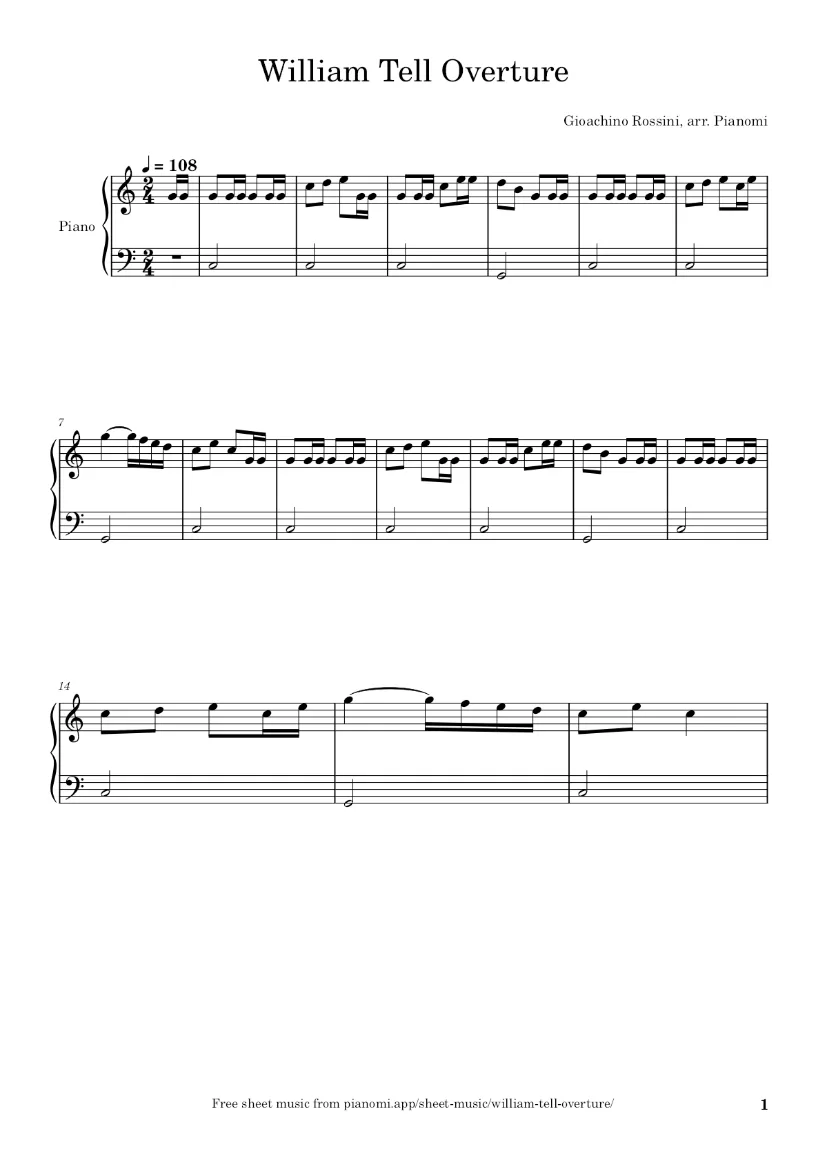
The tune’s notes by name, bar by bar (the right hand’s top line), bars 0–16. ♯ is a sharp, ♭ a flat: play the black key just above or below.
- G G
- G G G G G G
- C D E G G
- G G G C E E
- D B G G G
- G G G G G G
- C D E C E
- G F E D
- C E C G G
- G G G G G G
- C D E G G
- G G G C E E
- D B G G G
- G G G G G G
- C D E C E
- G F E D
- C E C
The names alone leave out the rhythm and the left hand: the music above has both, and the score with note names prints every note’s name under it.
About William Tell Overture
Gioachino Rossini’s William Tell (Guillaume Tell), a grand opera in four acts after Schiller’s play Wilhelm Tell, was first performed at the Paris Opéra on 3 August 1829. It was his last opera. Its overture ends with a fast finale: a trumpet call, and then the whole orchestra races through a galloping tune, a repeated note in a quick “da-da-dum” rhythm that climbs and falls. Much later it became the theme of The Lone Ranger on radio and television.
This arrangement is Pianomi’s own. It follows the theme as the piano reduction of the overture in Léon Grus’s vocal score (Paris, about 1870) has it, moved from E major to C major, so there are no sharps. The orchestra plays the eight-bar tune twice, the second time an octave higher; here both times are at the same pitch, and the last C is held where the galop runs on. The trumpet call before it is left out. The left hand plays one note a bar, C or G, the roots of the harmony.
How hard is William Tell Overture?
It’s a little harder than a first piece: the sixteenth notes keep coming and need a light, even touch, and the tied note in bar 7 needs careful counting. The notes themselves stay within an octave, from the G above middle C to the G above that, and the left hand plays long notes.
It reads like level 40 of 44, “Sixteenth notes”: grade 2 to 3 in graded exams’ sight reading, roughly. Its hands, chords and rhythm read like level 40, sixteenth notes. On top of that: moving out of position. Practise reading at that level with the free sight-reading exercises.
How to practise it
The gallop is one rhythm over and over: an eighth note and two sixteenths, “long, short-short”, counted “1, and-a, 2, and-a”. Practise it on one key first, the G above middle C, until it’s even and relaxed, then play the tune. It starts with a pick-up of two sixteenths, and most bars begin on that repeated G.
Between the repeated notes the tune climbs C, D, E and falls D, B, G. In bar 7 the high G is held over the beat, a quarter tied to a sixteenth, before three sixteenths run down F, E, D: count it carefully. Bars 9 to 16 are bars 1 to 8 again, with a held C to end. The left hand plays the C below middle C and the G below it, one note a bar: learn it alone first. The orchestra plays it much faster than this.
The score
- Composer
- Gioachino Rossini
- Key
- C major
- Time
- 2/4
- Tempo
- ♩ = 108
- Length
- 17 bars, under a minute with its repeats
- Range
- G2 to G5
Arranged for piano by Pianomi, from a tune in the public domain.