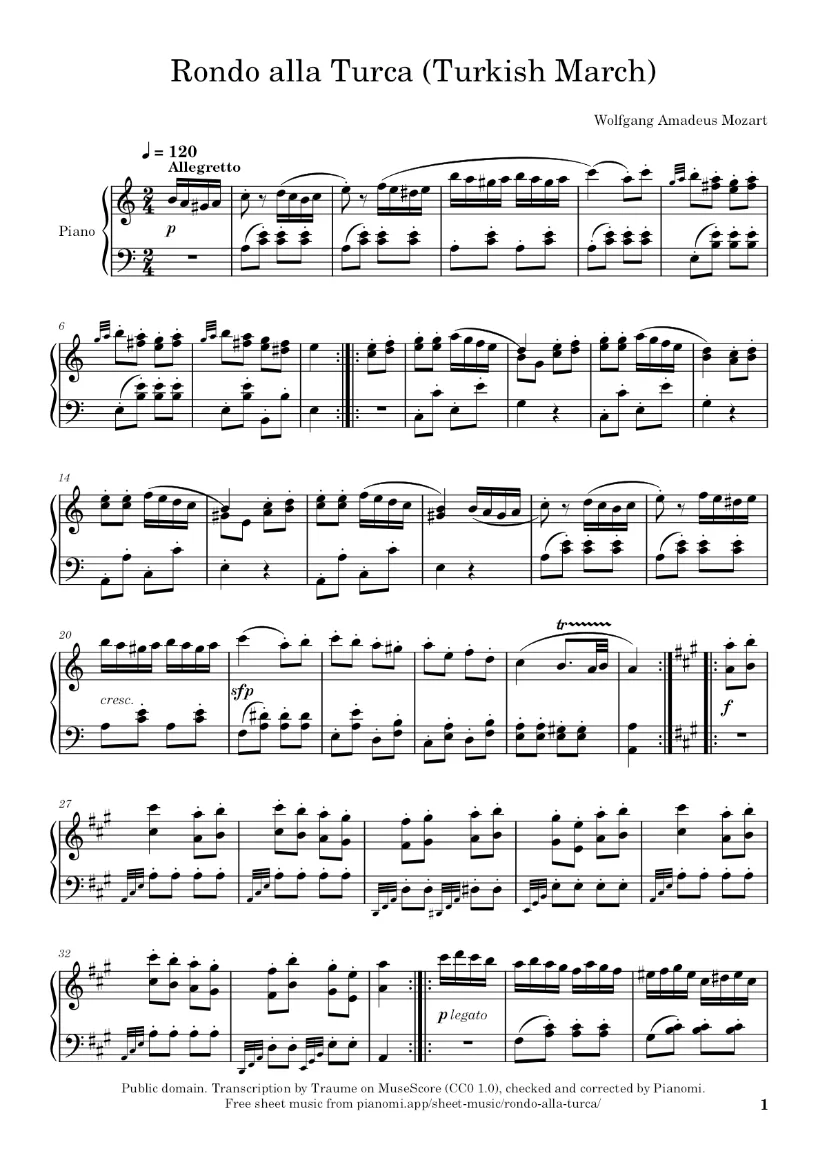
About Rondo alla Turca
Mozart’s Sonata in A major, K. 331, was printed in Vienna in 1784. Its three movements are a theme with variations, a minuet and, last, this rondo, which Mozart himself marked Alla turca: in the Turkish style. It imitates the Turkish military bands that were fashionable in Vienna, with their drums and cymbals. The left hand plays a bass note and then chords, over and over, like a drum, and quick grace notes flick in the right hand.
The tune is easy to find. It starts with an upbeat of four quick notes (B, A, G♯, A) and rises into A minor, repeated an octave higher in bar 3. Later the music turns to C major, and from bar 27 to A major, where the right hand plays in octaves over a left hand that repeats a low A. A long coda in A major closes the movement with octave runs and big chords.
How hard is Rondo alla Turca?
The first page is within reach of a pianist with a few years of lessons. The whole movement is a late intermediate piece, because of the quick fingerwork of the tune, the octaves in the A major sections and the chords of the coda, all of which sound best at a steady, moderate speed.
At sight, it’s harder to read than all 44 of Pianomi’s sight-reading levels, which end at about grade 3 sight reading, at gentle tempos. What takes it past them: big jumps, four-note chords and busy hands together. On top of that: 3 sharps, rests, accidentals, moving out of position, chords with sharps or flats and left-hand jumps.
How to practise it
Start with the left hand, which keeps nearly the same shape all the way: a bass note, then a chord on the off-beat (bar 1: A, then C and E twice). Make it light and even, like a distant drum, and keep the right hand’s tune above it.
Learn the quick four-note turns in the right hand slowly and evenly. They give the tune its character, and they only sound right when each one is clean and the beat stays steady. From bar 27, practise the octave tune hands apart with a loose hand before joining.
Mozart marks it Allegretto, a moderate speed: aim for a march, not a race. Bar numbers here count the upbeat as bar 0 and a bar split by a repeat sign as two, so later in the movement they run ahead of some printed editions.
The score
- Composer
- Wolfgang Amadeus Mozart (1756–1791)
- Catalogue
- K. 331 (300i)
- Written
- 1783
- Key
- A minor
- Time
- 2/4
- Tempo
- Allegretto, ♩ = 120
- Length
- 137 bars, about 3½ minutes with its repeats
- Range
- A2 to E6
Transcribed by Traume on MuseScore and given to the public domain (CC0 1.0). We compared every note with other transcriptions and early editions and corrected it where it was wrong.