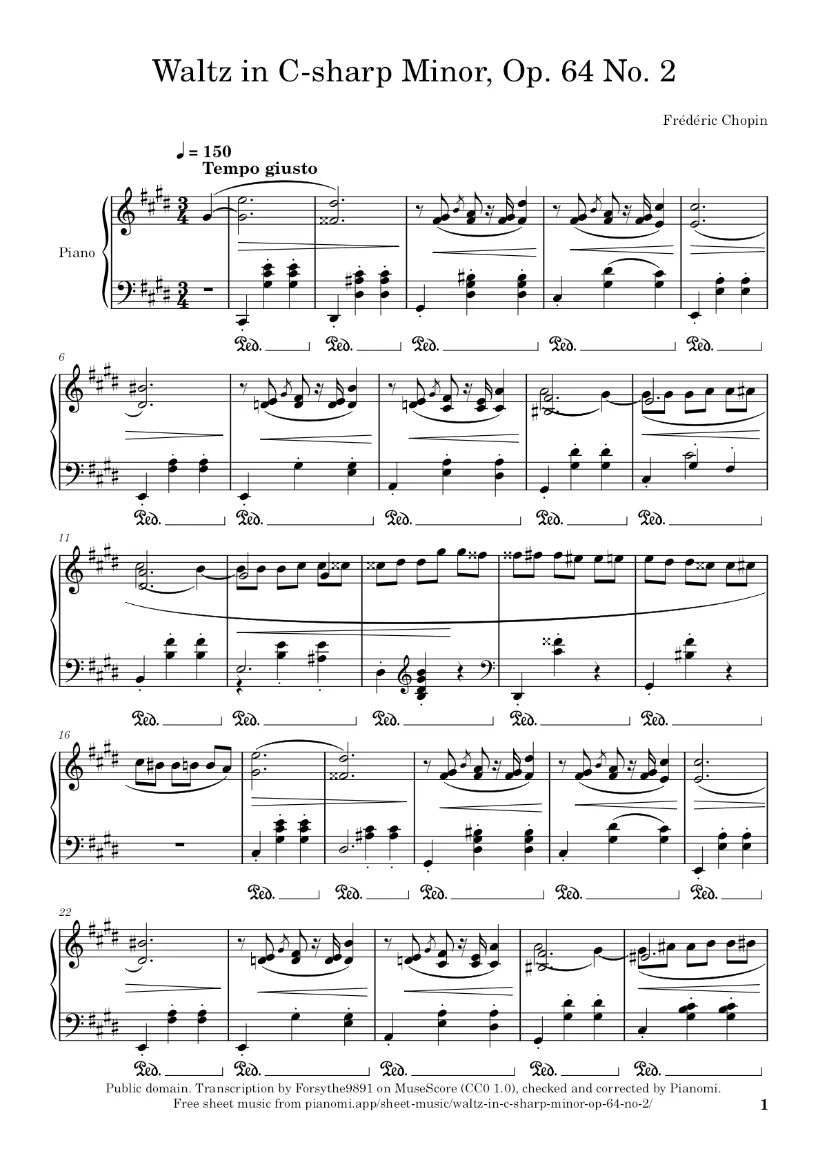
About Waltz in C♯ Minor, Op. 64 No. 2
Chopin wrote the three waltzes of Op. 64 in 1846 and 1847, near the end of his life, and they were printed in 1847. This second one is dedicated to Madame Nathaniel de Rothschild. The first of the set is the Minute Waltz. These are waltzes to listen to, not to dance to.
The waltz begins on a single upbeat note, and the tune circles in the right hand over a left hand that plays the waltz pattern: a low bass note on the first beat and a chord on beats two and three. The key is C♯ minor. Chopin marks it Tempo giusto, in strict time, though pianists give the tune a little give and take over the steady left hand. In the middle, at bar 65, the Più lento (slower) turns to D♭ major and the music relaxes. The opening returns at bar 98.
How hard is Waltz in C♯ Minor, Op. 64 No. 2?
It is a late intermediate piece. The waltz pattern and the tune are within reach of an intermediate pianist, but the left hand’s long jumps, the quick decorations in the right hand and the flexible timing take time to get right, and it needs careful pedalling.
At sight, it’s harder to read than all 44 of Pianomi’s sight-reading levels, which end at about grade 3 sight reading, at gentle tempos. What takes it past them: big jumps and four-note chords. On top of that: 5 flats, 4 sharps, rests, accidentals, moving out of position, chords with sharps or flats and left-hand jumps.
How to practise it
Learn the left hand first. In the opening it jumps from a low bass note (C♯2 in bar 1) up more than an octave to a chord on beats two and three. Practise the jump until you can find the chord without looking, and keep beats two and three much quieter than beat one.
In the first section the tune moves mostly by step and small leaps, so work on its shape: let each phrase rise to its high point and fall away, with the left hand quiet underneath.
The Più lento is in D♭ major, which has five flats, while the opening has four sharps. It is calmer and slower: the right hand sings a long tune while the left hand plays the waltz pattern more gently. Don’t rush, and give the long notes their full length. Bar numbers here count the upbeat as bar 0. From the Più lento on they are one higher than in the first editions, which count the bar split by the double barline once.
The score
- Composer
- Frédéric Chopin (1810–1849)
- Catalogue
- Op. 64 No. 2
- Written
- 1846–1847
- Key
- C♯ minor
- Time
- 3/4
- Tempo
- Tempo giusto, ♩ = 150
- Length
- 194 bars, about 4 minutes with its repeats
- Range
- G♯1 to C♯7
Transcribed by Forsythe9891 on MuseScore and given to the public domain (CC0 1.0). We compared every note with other transcriptions and early editions and corrected it where it was wrong.