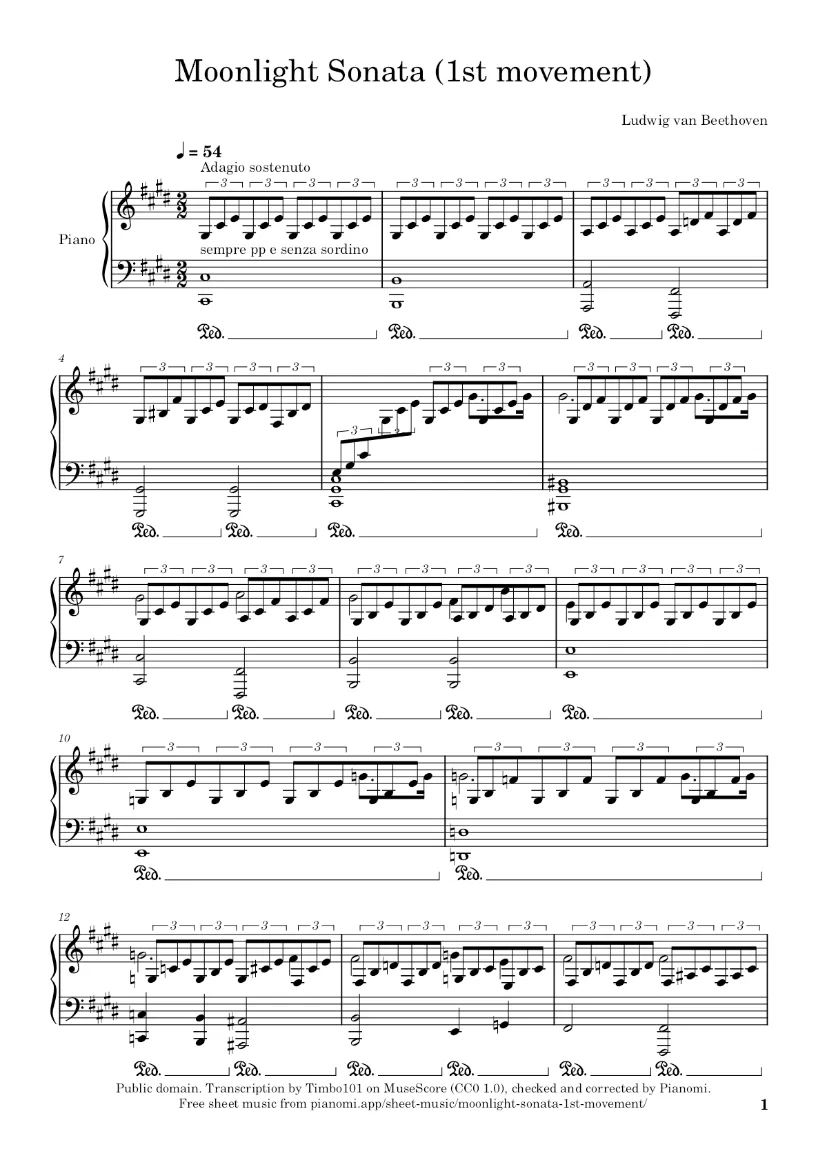
About Moonlight Sonata, 1st Movement
Beethoven wrote the sonata in 1801 and it was printed in 1802, dedicated to his pupil Countess Giulietta Guicciardi. He called it Sonata quasi una fantasia, a sonata that is almost a fantasy, and it opens with a slow movement, where a sonata usually began fast. The name Moonlight isn’t his. It is usually traced to the poet and critic Ludwig Rellstab, who compared the first movement to moonlight on a lake.
The marking is Adagio sostenuto, and Beethoven asks for the whole movement to be played very softly and without dampers (senza sordino). The right hand never stops its triplets, and the left hand plays slow octaves beneath. After four bars of that alone, the tune comes in at the end of bar 5: a low, plain melody that moves very little.
The middle of the movement builds. From bar 32 the right hand’s broken chords climb to a high C at the top of bars 35 and 36, then sink to the low notes below middle C. The tune returns at bar 42, and near the end the triplets sweep up and down twice (bars 62 to 65) before the movement dies away on a quiet C♯ minor chord.
How hard is Moonlight Sonata, 1st Movement?
The notes are slow and the pattern hardly changes, so a pianist with a few years of lessons can learn them. What is hard is control: triplets that stay even and quiet for five minutes, a tune that sings over them and a bass that never thumps. It is a late intermediate piece, and many players start with the first page alone. There’s an easy version of its tune on a page of its own.
It reads like level 41 of 44, “Triplets”: grade 2 to 3 in graded exams’ sight reading, roughly. Its hands, chords and rhythm read like level 41, triplets. On top of that: 4 sharps, rests, accidentals, moving out of position, chords with sharps or flats and left-hand jumps. The hardest bars are 5, 30, 32 and 35. Practise reading at that level with the free sight-reading exercises.
How to practise it
Learn the triplets and the bass separately before you put them together. Play the right hand’s triplets with the lightest touch you can, fingers close to the keys, so the three notes of each beat are equal and none of them speaks louder. Play the left-hand octaves slowly and land on both notes together.
Then bring in the tune. It shares the right hand with the triplets, and the tune note often sounds together with the first triplet note of the beat. Give the tune a little more weight and keep the triplet notes under it softer. Many players take the tune with the fifth finger and let the others play lightly.
On the pedal: Beethoven’s direction means the dampers stay up for the whole movement. A modern piano rings longer than the pianos of his day, so most players change the pedal with each new bass note, to keep the harmonies clear. The hardest bars to keep even are 32 to 36, where the arpeggios climb and both hands share the triplets, and the sweeps in bars 62 to 65. Learn those slowly, hands apart first.
The score
- Composer
- Ludwig van Beethoven (1770–1827)
- Catalogue
- Op. 27 No. 2
- Written
- 1801
- Key
- C♯ minor
- Time
- 2/2
- Tempo
- Adagio sostenuto, ♩ = 54
- Length
- 69 bars, about 5 minutes with its repeats
- Range
- F1 to D♯6
Transcribed by Timbo101 on MuseScore and given to the public domain (CC0 1.0). We compared every note with other transcriptions and early editions and corrected it where it was wrong.