Nocturne in E♭ Major, Op. 9 No. 2 letter notes
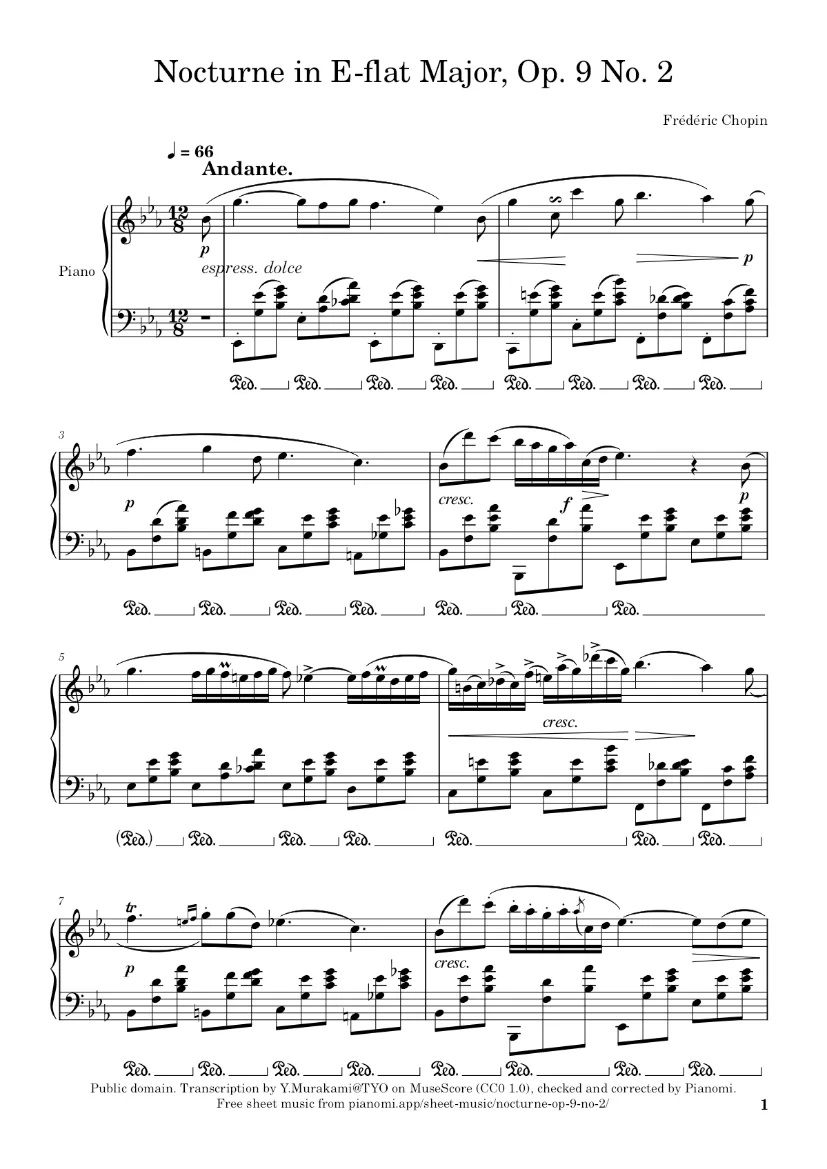
The tune’s notes by name, bar by bar (the right hand’s top line), bars 0–8. ♯ is a sharp, ♭ a flat: play the black key just above or below.
- B♭
- G F G F E♭ B♭
- G C C G B♭ A♭ G
- F G D E♭ C
- B♭ D C B♭ A♭ G A♭ C D E♭ B♭
- G F G F E F G F E♭ F E♭ D E♭ F
- G B C D♭ C F E A♭ G D♭ C G B♭ A♭ G
- F G G D E♭ C
- B♭ D C B♭ A♭ G A♭ C D E♭ D E♭
The names alone leave out the rhythm and the left hand: the music above has both, and the score with note names prints every note’s name under it.
About Nocturne in E♭ Major, Op. 9 No. 2
Chopin wrote the three nocturnes of Op. 9 as a young man, between 1830 and 1832, and they were printed in 1832, dedicated to the pianist Marie Pleyel. A nocturne is a night piece, a song for the piano. This second one, in E♭ major, is the best known of all Chopin’s nocturnes.
It is in 12/8: twelve eighths to a bar, felt as four beats of three. The left hand plays a bass note and then two chords above it, on each beat, in a swaying pattern that fills the whole piece. Over it the right hand sings the same tune several times, and each time Chopin adds more decoration: a run in bars 4 and 8, longer, faster runs in bars 16 and 24, and a high climb in octaves in bars 30 and 31. At bar 32 the music stops for a cadenza, a free passage in which the right hand circles a four-note figure high on the keyboard, before the last chords.
How hard is Nocturne in E♭ Major, Op. 9 No. 2?
It is a late intermediate piece. The notes of the tune are not hard, but the left hand’s wide pattern, the quick runs and the cadenza call for a relaxed hand and a good feel for time, and the give and take of Chopin’s rubato is part of the sound.
At sight, it’s harder to read than all 44 of Pianomi’s sight-reading levels, which end at about grade 3 sight reading, at gentle tempos. What takes it past them: its time signature and big jumps. On top of that: 3 flats, rests, accidentals, moving out of position and chords with sharps or flats.
How to practise it
Learn the left hand first. On each beat it plays a bass note, then two chords, and the reach is wide: the bass can be more than two octaves below the top note of the chord. Practise slowly with the pedal, changing it with each bass note, and keep the chords much softer than the bass.
Practise each of the right hand’s runs alone, slowly, in groups of four notes, then fit it into the beat. The run must finish exactly where the next note of the tune is due. Keep the left hand steady while the right hand floats, with a little give and take of time, which is called rubato.
The cadenza in bar 32 is played at your own speed. The right hand repeats the same four-note figure twelve times, so work out a plan for it: how fast to begin, where to ease, and where to place the last notes. Chopin’s three first editions differ in a number of small notes, so another printed copy may differ from this one in a note or two.
The score
- Composer
- Frédéric Chopin (1810–1849)
- Catalogue
- Op. 9 No. 2
- Written
- 1830–1832
- Key
- E♭ major
- Time
- 12/8
- Tempo
- Andante, ♩. = 44
- Length
- 35 bars, about 3½ minutes with its repeats
- Range
- G♯1 to D♯7
Transcribed by Y.Murakami@TYO on MuseScore and given to the public domain (CC0 1.0). We compared every note with other transcriptions and early editions and corrected it where it was wrong.