Raindrop Prelude, Op. 28 No. 15 letter notes
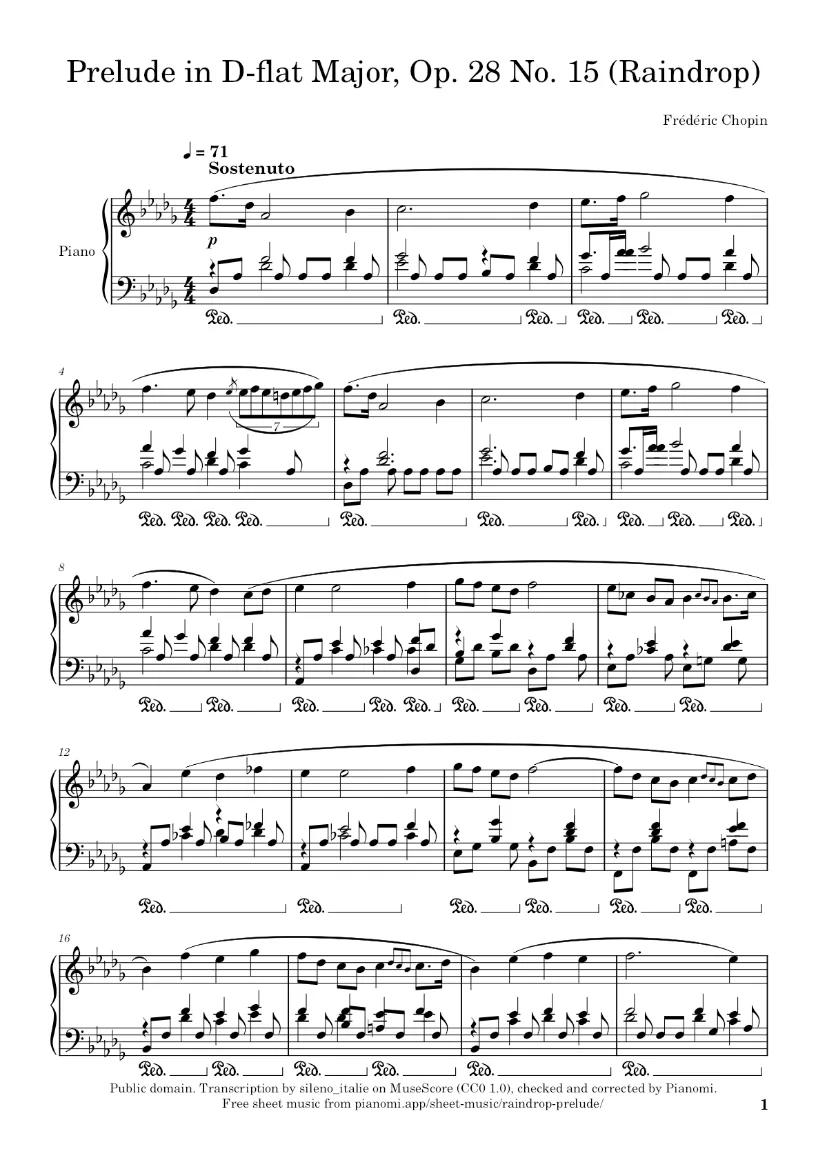
The tune’s notes by name, bar by bar (the right hand’s top line), bars 1–13. ♯ is a sharp, ♭ a flat: play the black key just above or below.
- F D♭ A♭ B♭
- C D♭
- E♭ F G♭ F
- F E♭ D♭ E♭ F E♭ D E♭ F G♭
- F D♭ A♭ B♭
- C D♭
- E♭ F G♭ F
- F E♭ D♭ C D♭
- E♭ E♭ F
- G♭ F E♭ D♭ F
- E♭ C♭ B♭ A♭ B♭ B♭ C♭
- A♭ E♭ D♭ F♭
- E♭ E♭ F
The names alone leave out the rhythm and the left hand: the music above has both, and the score with note names prints every note’s name under it.
About Raindrop Prelude, Op. 28 No. 15
Chopin finished his 24 Preludes, one in every major and minor key, on Majorca in the winter of 1838 and 1839, and the Raindrop is No. 15, in D♭ major. The name isn’t his. It comes from the A♭ that repeats, never stopping, through the whole piece, which many listeners hear as raindrops. One story ties it to rain on the roof at Valldemossa, where Chopin stayed with George Sand, but nobody can say he meant rain.
The piece has three parts. In the first (bars 1 to 27) a quiet D♭ major tune floats over the repeated A♭, which stays in the left hand. At bar 28 the key changes to C♯ minor, and the repeated note, now written as G♯, moves to the right hand while the left hand plays slow, heavy chords. The music grows darker and louder, and from bar 35 the repeated note is doubled in octaves. The tune returns in D♭ major at bar 76, and the repeated A♭ dies away over the last bars.
How hard is Raindrop Prelude, Op. 28 No. 15?
It is a late intermediate piece. The notes are not very fast, but it is long, about five minutes. The repeated note has to stay even without tiring the hand, and the middle section calls for control of volume and a steady pulse in the big octaves.
At sight, it’s harder to read than all 44 of Pianomi’s sight-reading levels, which end at about grade 3 sight reading, at gentle tempos. What takes it past them: busy hands together, big jumps and four-note chords. On top of that: 5 flats, 4 sharps, accidentals, moving out of position, chords with sharps or flats and left-hand jumps.
How to practise it
The first job is the repeated note. For the first 27 bars, and again from bar 76, it sounds in the left hand on nearly every half beat, so the left hand must play it softly and evenly without tiring, while it also plays chords and an inner line. Practise the left hand alone, then with the tune. If you hear the repeated note too much, play it more lightly.
In the middle section the repeated G♯ moves to the right hand, and from bar 35 it is played in octaves over big left-hand chords. Keep the wrist loose, play from the arm and practise it in short stretches with rests. Hear the left hand as the real melody here: the bass moves a step at a time and the harmony changes on the beat.
Bars 4 and 23 each end with a fast run of seven notes in the time of one beat. Practise it slowly, in small groups, so that it stays smooth and doesn’t hurry. Change the pedal with the bass note, and keep the left hand quiet beneath the tune.
The score
- Composer
- Frédéric Chopin (1810–1849)
- Catalogue
- Op. 28 No. 15
- Written
- 1838–1839
- Key
- D♭ major
- Time
- 4/4
- Tempo
- Sostenuto, ♩ = 71
- Length
- 89 bars, about 5 minutes with its repeats
- Range
- E1 to A♯5
Transcribed by sileno_italie on MuseScore and given to the public domain (CC0 1.0). We compared every note with other transcriptions and early editions and corrected it where it was wrong.