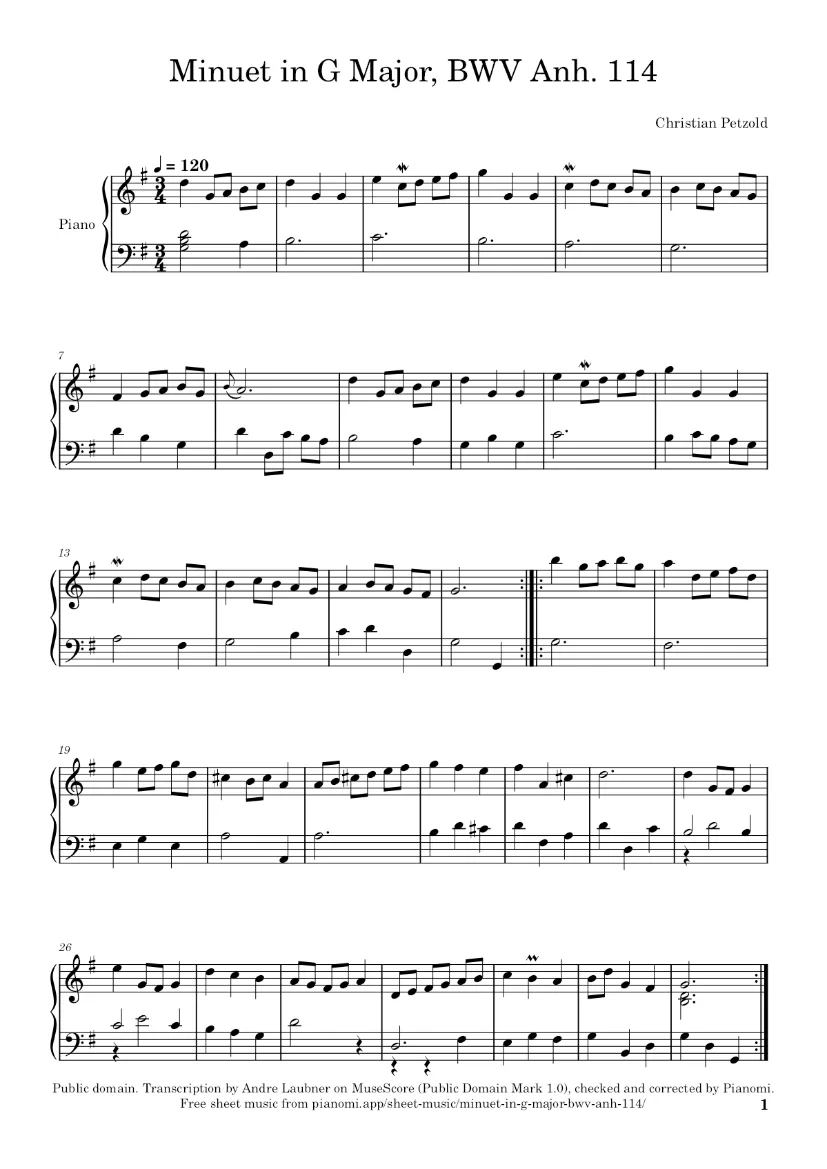
Minuet in G Major, BWV Anh. 114 letter notes
The tune’s notes by name, bar by bar (the right hand’s top line), bars 1–16. ♯ is a sharp, ♭ a flat: play the black key just above or below.
- D G A B C
- D G G
- E C D E F♯
- G G G
- C D C B A
- B C B A G
- F♯ G A B G
- A
- D G A B C
- D G G
- E C D E F♯
- G G G
- C D C B A
- B C B A G
- A B A G F♯
- G
The names alone leave out the rhythm and the left hand: the music above has both, and the score with note names prints every note’s name under it.
About Minuet in G Major, BWV Anh. 114
In 1725 Bach gave his wife, Anna Magdalena, a book of music to play from at home, and she copied this minuet and its partner in G minor into it herself. Because they were in the Bach family’s book, both were long thought to be his. In 1979 the Bach scholar Hans-Joachim Schulze found them in a harpsichord suite by Christian Petzold, an organist in Dresden.
It’s in two halves of 16 bars, each played twice. The right hand has the tune, in quarter notes and running eighths, and the left hand moves slowly underneath, one long note a bar at the start. The second half goes to D major, then finds its way home to G. In 1965 the tune became a pop song, A Lover’s Concerto, recorded by The Toys.
The easy arrangement is Pianomi’s own: the first half of the minuet, with the tune as written and the left hand playing one low note a bar.
How hard is Minuet in G Major, BWV Anh. 114?
No: it’s one of the first real pieces most pianists learn, often in their first year. The hands rarely move far, and the left hand is slow. Start with the easy version if playing hands together is new to you, then go on to the whole minuet.
It reads like level 30 of 44, “Accidentals”: grade 1 to 2 in graded exams’ sight reading, roughly. Its hands, chords and rhythm read like level 19, left-hand triads. On top of that: accidentals, moving out of position, left-hand jumps and one sharp. The hardest bar is 28. Practise reading at that level with the free sight-reading exercises.
How to practise it
Learn the right hand first. The eighth notes should run evenly, and the quarter notes can be slightly detached, which keeps the dance light. Count three beats in every bar, with a little weight on the first.
The ornaments are small decorations: mordents on the C in bars 3, 5, 11 and 13 (a quick C, B, C), a prall trill on the B in bar 30, and a small note before the A in bar 8, played on the beat and leaning onto the A. Leave them out until the notes are secure.
In the left hand, watch bars 25, 26 and 29, where it has two parts at once: hold the long notes while the other notes move.
The score
- Composer
- Christian Petzold (1677–1733)
- Catalogue
- BWV Anh. 114
- Written
- by 1725
- Key
- G major
- Time
- 3/4
- Tempo
- ♩ = 120
- Length
- 32 bars, about 1½ minutes with its repeats
- Range
- G2 to B5
Transcribed by Andre Laubner on MuseScore and given to the public domain (Public Domain Mark 1.0). We compared every note with other transcriptions and early editions and corrected it where it was wrong.