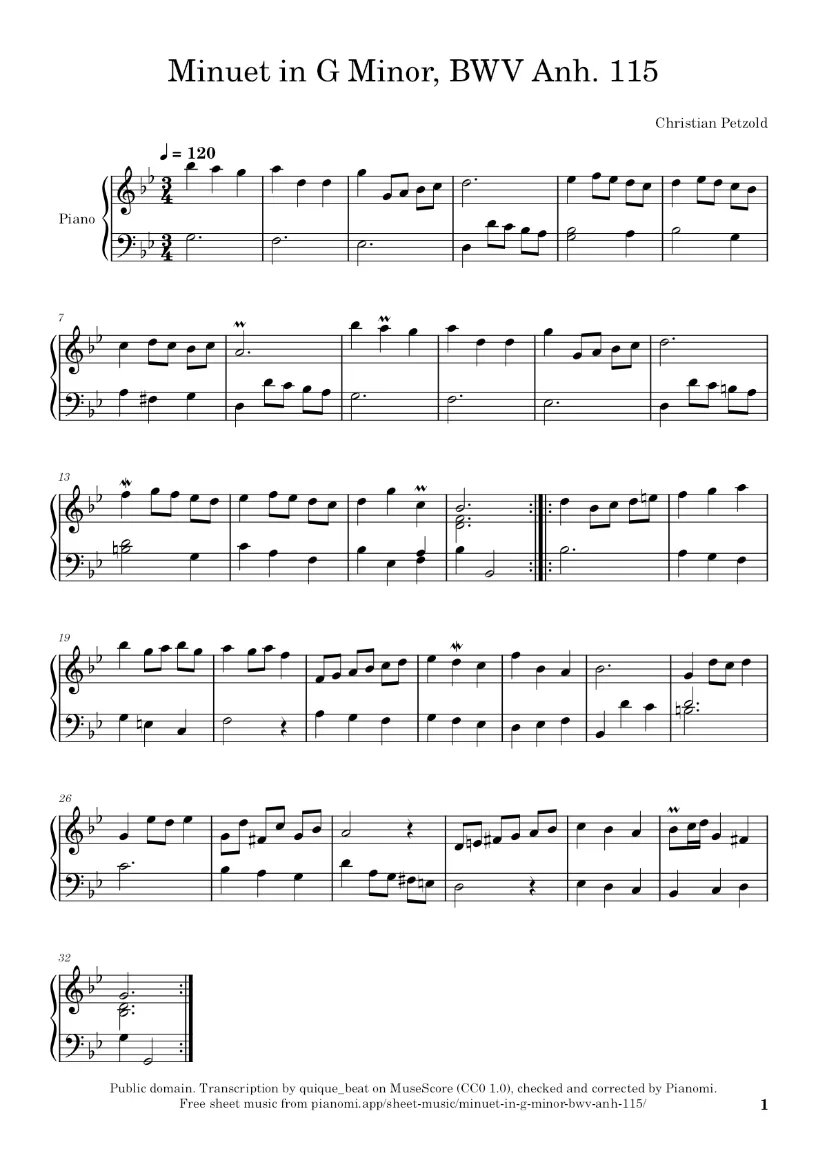
Minuet in G Minor, BWV Anh. 115 letter notes
The tune’s notes by name, bar by bar (the right hand’s top line), bars 1–16. ♯ is a sharp, ♭ a flat: play the black key just above or below.
- B♭ A G
- A D D
- G G A B♭ C
- D
- E♭ F E♭ D C
- D E♭ D C B♭
- C D C B♭ C
- A
- B♭ A G
- A D D
- G G A B♭ C
- D
- F G F E♭ D
- E♭ F E♭ D C
- D G C
- B♭
The names alone leave out the rhythm and the left hand: the music above has both, and the score with note names prints every note’s name under it.
About Minuet in G Minor, BWV Anh. 115
Like the Minuet in G major, it’s in the book of music Bach gave his wife, Anna Magdalena, in 1725, copied in her hand straight after the G major minuet. Both were long thought to be Bach’s, until in 1979 the Bach scholar Hans-Joachim Schulze found them in a harpsichord suite by Christian Petzold, an organist in Dresden.
The tune starts high and falls, over a slow left hand. Each half is 16 bars, played twice. The first half ends in B♭ major; the second visits F major and B♭ major before turning back to G minor, with F♯ and E♮ in the last bars.
The two minuets make a natural pair: play the G major minuet, then this one, then the G major again, as was usual with a pair of minuets.
How hard is Minuet in G Minor, BWV Anh. 115?
No: it’s a first-year piece, a little harder than its G major partner because of the jumps in the right hand and the two-note chords in the left. Learn it after the Minuet in G.
It reads like level 32 of 44, “Keys of D and B♭”: early grade 2 in graded exams’ sight reading, roughly. Its hands, chords and rhythm read like level 26, alberti bass. On top of that: 2 flats, accidentals, moving out of position, chords with sharps or flats and left-hand jumps. The hardest bars are 15, 24 and 31. Practise reading at that level with the free sight-reading exercises.
How to practise it
Learn the right hand first, keeping the quarter notes even and the eighth-note runs smooth. In bar 27 the right hand zigzags in eighths, G, D, F♯, C, G, B♭: practise it slowly until the hand knows the shape.
The left hand plays two notes together in bars 5, 13, 15 and 25: keep them even and hold them for their full length.
The ornaments are prall trills (bars 8, 9, 15 and 31) and mordents (bars 13 and 22): quick decorations, best added once the notes are sure.
The score
- Composer
- Christian Petzold (1677–1733)
- Catalogue
- BWV Anh. 115
- Written
- by 1725
- Key
- G minor
- Time
- 3/4
- Tempo
- ♩ = 120
- Length
- 32 bars, about 1½ minutes with its repeats
- Range
- G2 to A♯5
Transcribed by quique_beat on MuseScore and given to the public domain (CC0 1.0). We compared every note with other transcriptions and early editions and corrected it where it was wrong.