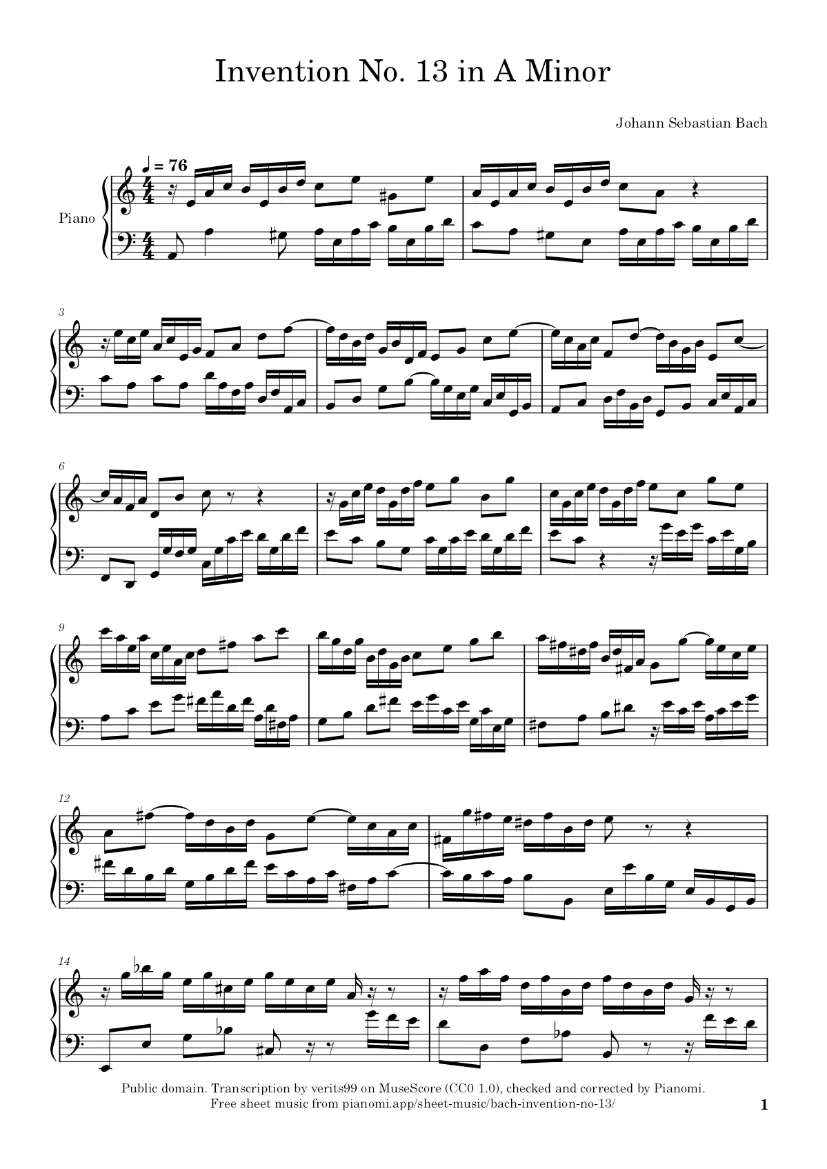
About Invention No. 13 in A Minor, BWV 784
One of the fifteen two-part inventions Bach wrote out in 1723 to teach playing in two parts. Like the others, an earlier version is in the keyboard book he began in 1720 for his eldest son, Wilhelm Friedemann.
Almost every beat is a chord spread out. The right hand starts with A minor broken in sixteenths, then eighth notes, and the left hand answers with the same figure. In bars 3 to 6 the harmony moves down a chain of chords, with notes tied over the beat. The music passes through C major in bar 8 and E minor in bar 13; in bars 14 to 17 it runs down through four tense chords, one a bar, each stopping on a short rest, before the opening returns in bar 18. It ends on a bare A.
How hard is Invention No. 13 in A Minor, BWV 784?
It’s an intermediate piece. The notes follow chord shapes, which makes them easier to learn than they look, but the wide spreads of the hand and the steady sixteenths in both hands need careful practice.
At sight, it’s harder to read than all 44 of Pianomi’s sight-reading levels, which end at about grade 3 sight reading, at gentle tempos. What takes it past them: busy hands together and big jumps. On top of that: syncopation, rests, accidentals, moving out of position and left-hand jumps.
How to practise it
Play each beat’s broken chord as a block chord first, to learn the shapes. The hand often spans a sixth or a seventh within a beat, as in the first bar and in bar 24, and it helps to know where it’s going before you spread the notes.
Keep the sixteenths smooth and the eighth notes a little detached, the same in both hands. In bars 3 to 6, hold each tied note its full length while the other notes move around it. In bar 19 both hands play sixteenths together: practise it hands separately, then slowly together.
The score
- Composer
- Johann Sebastian Bach (1685–1750)
- Catalogue
- BWV 784
- Written
- 1723
- Key
- A minor
- Time
- 4/4
- Tempo
- ♩ = 76
- Length
- 25 bars, about 1½ minutes with its repeats
- Range
- D2 to C6
Transcribed by verits99 on MuseScore and given to the public domain (CC0 1.0). We compared every note with other transcriptions and early editions and corrected it where it was wrong.