Sonata in C Major, K. 545: 1st Movement letter notes
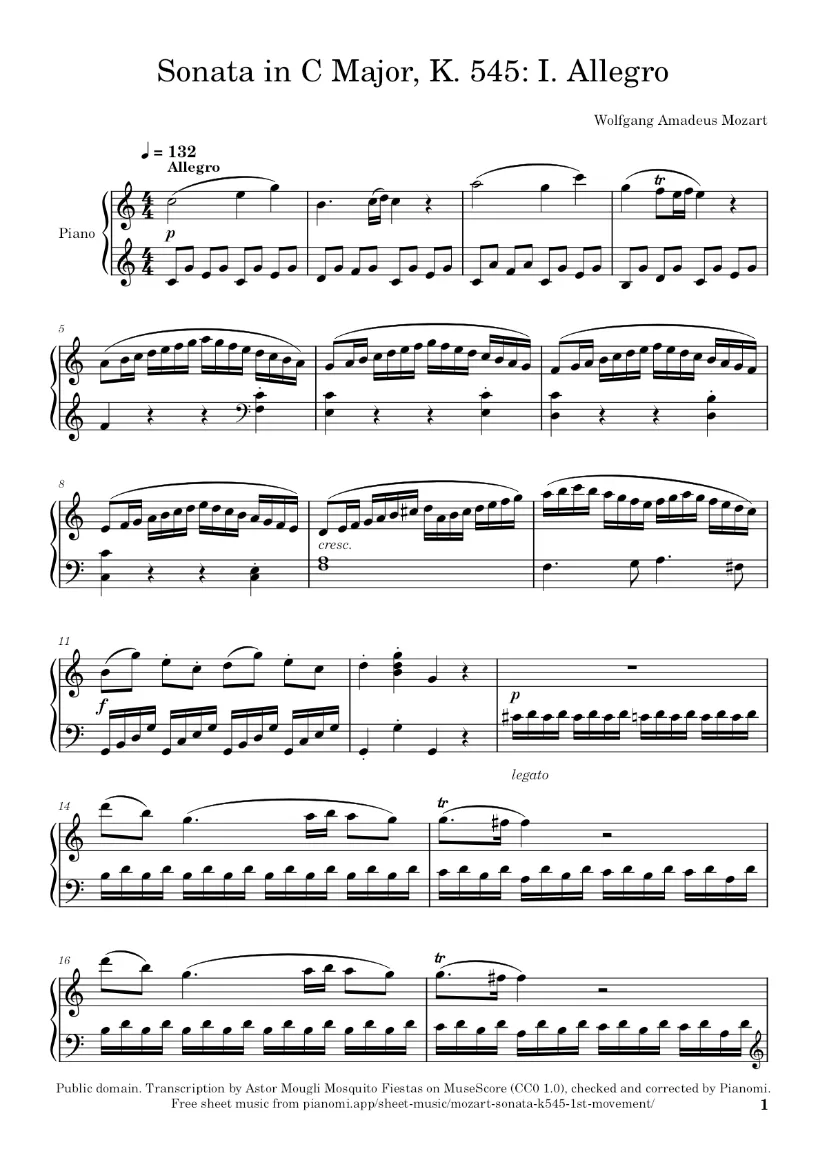
The tune’s notes by name, bar by bar (the right hand’s top line), bars 1–10. ♯ is a sharp, ♭ a flat: play the black key just above or below.
- C E G
- B C D C
- A G C
- G F E F E
- A B C D E F G A G F E D C B A
- G A B C D E F G F E D C B A G
- F G A B C D E F E D C B A G F
- E F G A B C D E D C B A G F E
- D E F G A B C♯ D A B C♯ D E F G
- A B C B A G F E F G A G F E D C
The names alone leave out the rhythm and the left hand: the music above has both, and the score with note names prints every note’s name under it.
About Sonata in C Major, K. 545: 1st Movement
Mozart entered this sonata in his own catalogue on 26 June 1788 as a little piano sonata for beginners. It was printed only in 1805, after his death. The nickname Sonata facile (easy sonata) isn’t his. It is easy for the hands, but not for the ear: with so few notes, every one of them shows.
The first tune (bars 1 to 4) is a C major tune over a broken-chord left hand, and bars 5 to 10 answer it with running scales. The second theme arrives in G major at bar 14, over a left hand that repeats two notes. The short middle section starts at bar 29 in G minor and passes through D minor, with scales running from hand to hand. Then comes the quirk everyone remembers: the first tune returns at bar 42 in F major, not C, and the second theme brings the music home to C major.
How hard is Sonata in C Major, K. 545: 1st Movement?
The notes are within reach of a pianist in their second or third year, and it is often the first Mozart sonata that people learn. Playing it well is harder: the scales must be even, the left hand quiet and the ornaments exact. It is an intermediate piece.
At sight, it’s harder to read than all 44 of Pianomi’s sight-reading levels, which end at about grade 3 sight reading, at gentle tempos. What takes it past them: busy hands together and big jumps. On top of that: rests, accidentals, dotted rhythms, moving out of position and left-hand jumps.
How to practise it
The left hand has the same pattern for most of the first page, the Alberti bass: lowest note, top note, middle note, top note (C, G, E, G in bar 1). Make it a quiet, even pulse so the tune can sing. The tune is made of leaps through the chord and steps between them, so give it a clear shape, as a singer would.
The scales in bars 5 to 10 sound easy and aren’t. Practise them slowly, in groups, with a metronome, and keep every note the same length and weight. Mozart’s music has nowhere to hide, so an uneven scale shows at once.
The long note in bar 25 carries a trill, and so does the one in bar 70: start it slowly and end it with the two small notes written after it. In bars 35 to 40 the hands pass a scale back and forth. Practise each hand alone until it is smooth, then join them and aim for one line of sound.
The score
- Composer
- Wolfgang Amadeus Mozart (1756–1791)
- Catalogue
- K. 545
- Written
- 1788
- Key
- C major
- Time
- 4/4
- Tempo
- Allegro, ♩ = 132
- Length
- 73 bars, about 4½ minutes with its repeats
- Range
- C2 to F6
Transcribed by Astor Mougli Mosquito Fiestas on MuseScore and given to the public domain (CC0 1.0). We compared every note with other transcriptions and early editions and corrected it where it was wrong.