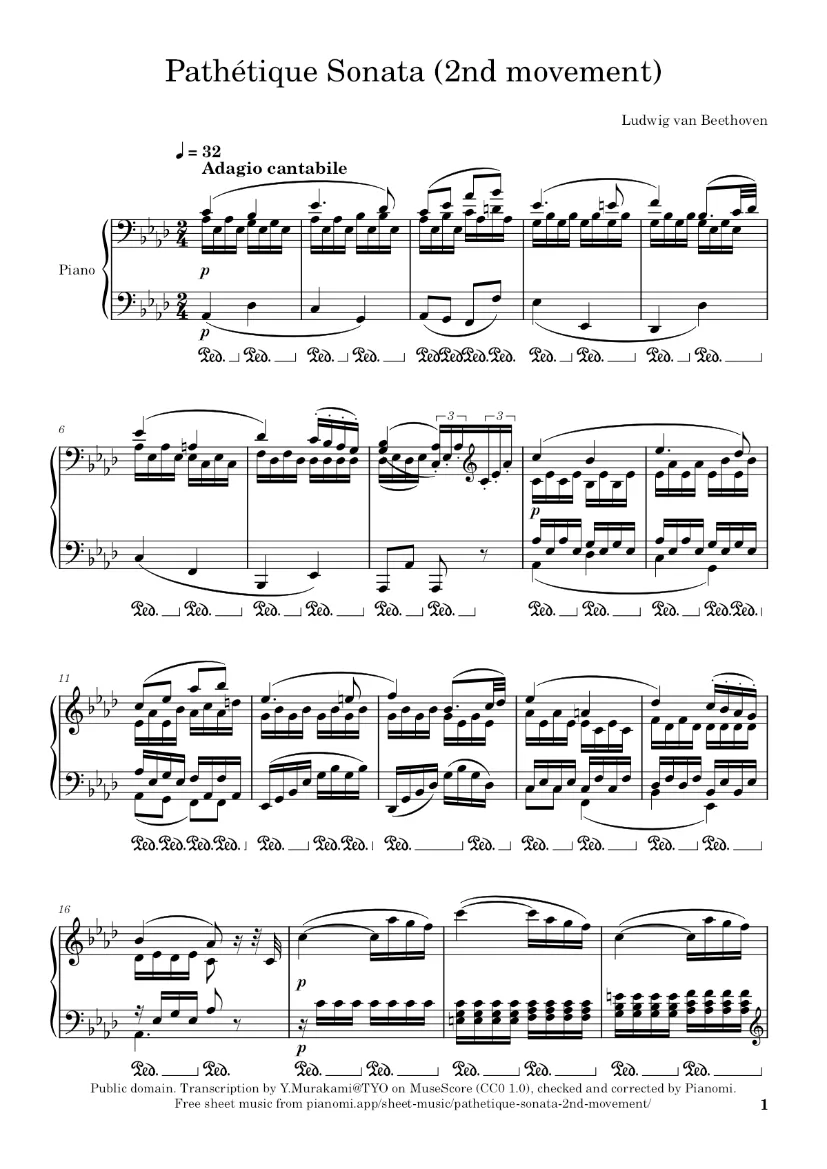
About Pathétique Sonata, 2nd Movement
Beethoven wrote the Pathétique Sonata in 1798, and it was printed in 1799 as Grande sonate pathétique, dedicated to his friend and patron Prince Karl von Lichnowsky. The other two movements are stormy and in C minor. The Adagio cantabile, which means slowly and in a singing style, is the calm one between them.
It is a rondo: the tune comes back twice, at bars 29 and 51, with a different episode before each return. The first time, bars 9 to 16 play the tune again with it doubled in octaves. The first episode (bar 17) has the left hand repeating chords under a rising right-hand line. The second (bar 37) is darker, with the right hand repeating chords in triplets. When the tune comes back for the last time, the accompaniment moves in triplets too, and a short coda closes the movement quietly.
How hard is Pathétique Sonata, 2nd Movement?
The notes are not hard and the tempo is slow, so it is within reach of an intermediate pianist. What takes work is the touch: a tune that sings over repeated notes in the same hand, soft and even for four and a half minutes, and the triplet figures near the end.
At sight, it’s harder to read than all 44 of Pianomi’s sight-reading levels, which end at about grade 3 sight reading, at gentle tempos. What takes it past them: big jumps, busy hands together and four-note chords. On top of that: 4 flats, rests, accidentals, dotted rhythms, moving out of position, chords with sharps or flats and left-hand jumps.
How to practise it
The first thing to learn is how the right hand does two jobs. The tune is the top voice, and underneath it the same hand repeats soft notes in sixteenths. Practise the repeated notes alone until they are even and quiet, then add the tune on top and give it the weight, as if a singer were on top of the accompaniment. The left hand plays a slow bass line.
Play the tune legato, joining each note to the next and holding it its full length, and use the pedal to link the harmonies, changing it with the bass. This edition begins the right hand’s staff in the bass clef, as some printed editions do, because the tune starts low: read it that way until the clef changes.
Two places need extra work. In bars 55 and 63 a quick dotted figure ends the bar against the accompaniment’s triplets, and many players place its last two short notes with the last triplet sixteenth. In the episode from bar 37 the right hand repeats a chord six times a beat; practise it with a loose wrist so the sound stays quiet.
The score
- Composer
- Ludwig van Beethoven (1770–1827)
- Catalogue
- Op. 13
- Written
- 1798
- Key
- A♭ major
- Time
- 2/4
- Tempo
- Adagio cantabile, ♩ = 32
- Length
- 73 bars, about 4½ minutes with its repeats
- Range
- F1 to F6
Transcribed by Y.Murakami@TYO on MuseScore and given to the public domain (CC0 1.0). We compared every note with other transcriptions and early editions and corrected it where it was wrong.