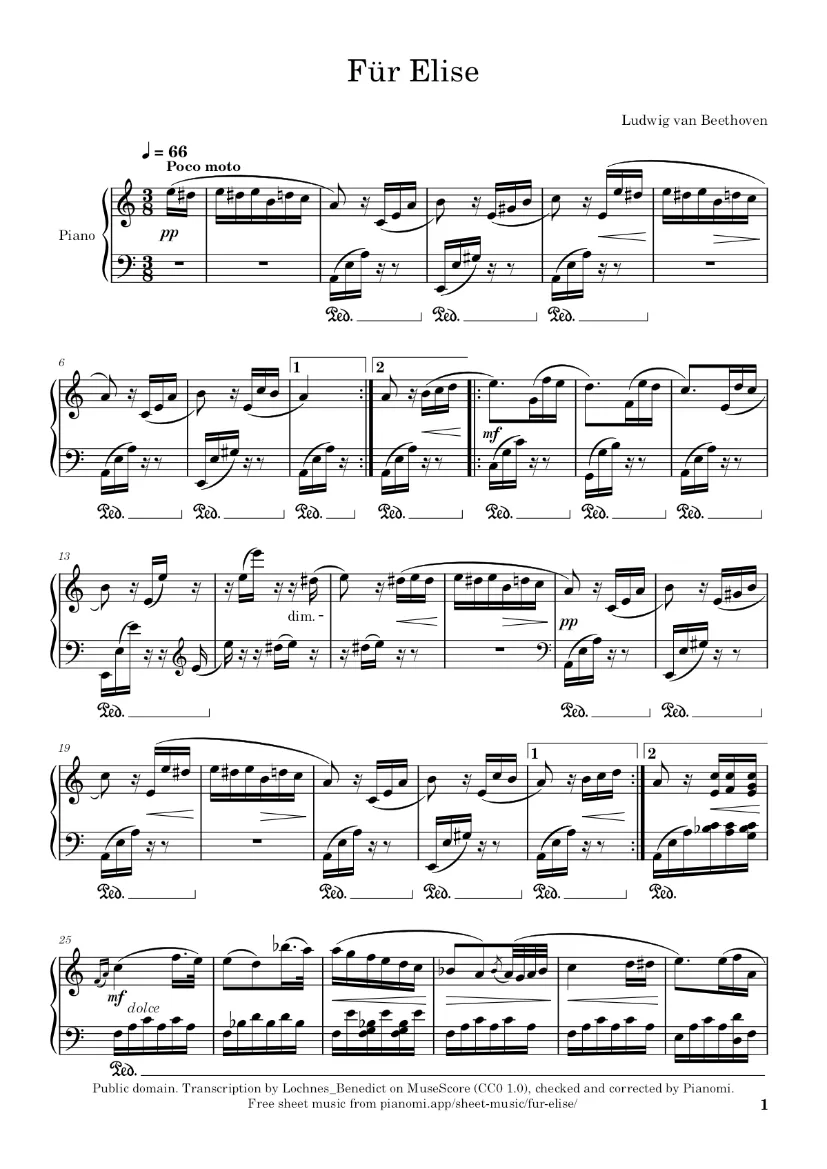
Für Elise letter notes
The tune’s notes by name, bar by bar (the right hand’s top line), bars 0–22. ♯ is a sharp, ♭ a flat: play the black key just above or below.
- E D♯
- E D♯ E B D C
- A C E A
- B E G♯ B
- C E E D♯
- E D♯ E B D C
- A C E A
- B E C B
- A
- A B C D
- E G F E
- D F E D
- C E D C
- B E E
- E E D♯
- E D♯ E D♯
- E D♯ E B D C
- A C E A
- B E G♯ B
- C E E D♯
- E D♯ E B D C
- A C E A
- B E C B
The names alone leave out the rhythm and the left hand: the music above has both, and the score with note names prints every note’s name under it.
About Für Elise
Beethoven wrote Für Elise in 1810, but it wasn’t printed until 1867, forty years after his death, when the scholar Ludwig Nohl published it from a manuscript that has since been lost. Nobody knows for certain who Elise was. One idea is that Nohl misread the name, and the piece was for Therese Malfatti, a pupil Beethoven hoped to marry.
It’s a rondo: the famous tune comes back three times, with two different episodes between. The first is brighter, in F major and C major, with quick runs. The second is darker, over a low A repeated in the left hand, and climbs through a broken chord to a chromatic run down before the tune returns for the last time. Most people only know the first page.
How hard is Für Elise?
The first section, with the famous tune, is within reach once you can play hands together and use the pedal: many pianists learn it in their first two years. The whole piece is harder, an intermediate piece, because the middle episodes have quick runs, repeated notes and chords. For a first go, start with the easy arrangement.
At sight, it’s harder to read than all 44 of Pianomi’s sight-reading levels, which end at about grade 3 sight reading, at gentle tempos. What takes it past them: its time signature, busy hands together and four-note chords. On top of that: rests, accidentals, moving out of position and left-hand jumps.
How to practise it
Start with the tune. The right hand rocks between E and D♯, then the hands share a broken chord, the left hand starting it and the right hand finishing it. Practise those handovers slowly until the notes run evenly from one hand to the other, changing the pedal with each new chord.
The F major episode needs a light hand for its quick runs: learn them in small groups, then join them. In the episode over the low A, keep the repeated notes soft and even, and let the right hand’s chords lead.
Don’t play it fast. Poco moto means just a little movement, and a steady, quiet tempo sounds far better than a quick one. Choose Right or Left above the music to hear each hand on its own.
The score
- Composer
- Ludwig van Beethoven (1770–1827)
- Catalogue
- WoO 59
- Written
- 1810
- Key
- A minor
- Time
- 3/8
- Tempo
- Poco moto, ♩ = 66
- Length
- 106 bars, about 3 minutes with its repeats
- Range
- A1 to E7
Transcribed by Lochnes_Benedict on MuseScore and given to the public domain (CC0 1.0). We compared every note with other transcriptions and early editions and corrected it where it was wrong.