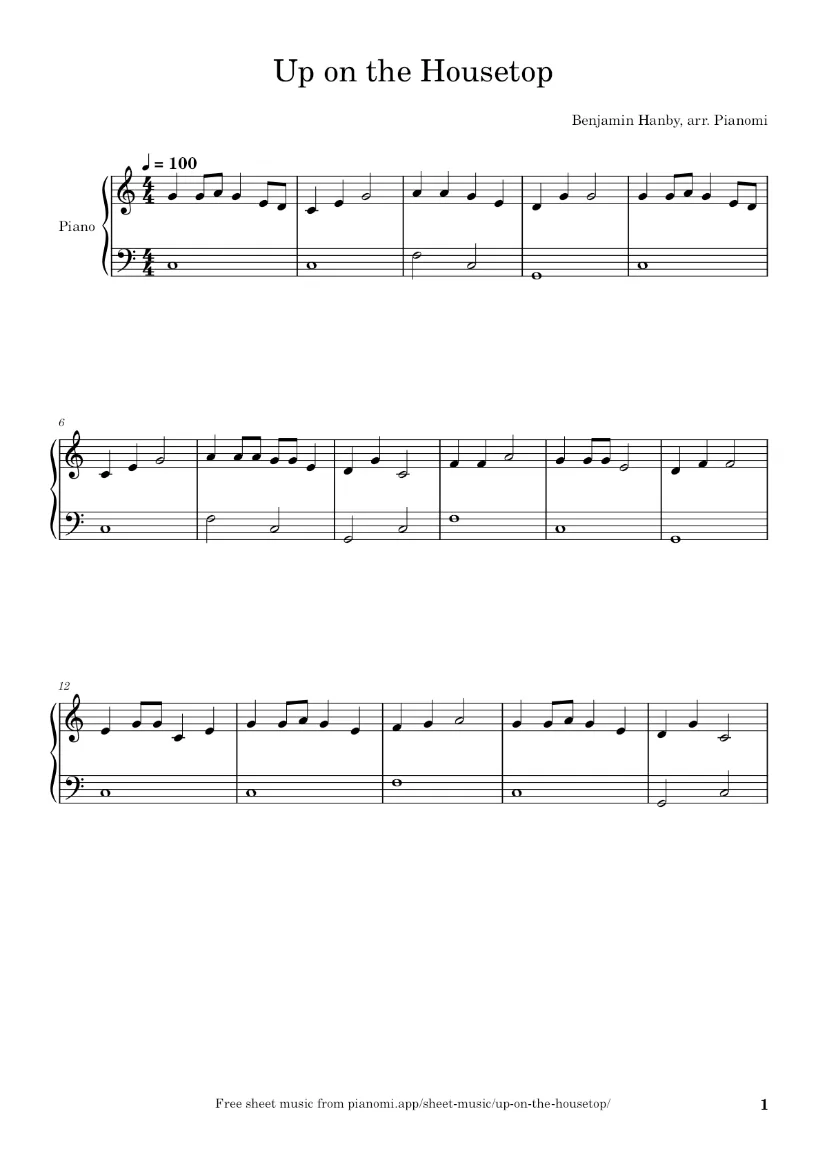
Up on the Housetop letter notes
The tune’s notes by name, bar by bar (the right hand’s top line), bars 1–16. ♯ is a sharp, ♭ a flat: play the black key just above or below.
- G G A G E D
- C E G
- A A G E
- D G G
- G G A G E D
- C E G
- A A A G G E
- D G C
- F F A
- G G G E
- D F F
- E G G C E
- G G A G E
- F G A
- G G A G E
- D G C
The names alone leave out the rhythm and the left hand: the music above has both, and the score with note names prints every note’s name under it.
About Up on the Housetop
Benjamin Hanby, an Ohio songwriter best known for Darling Nelly Gray, wrote the words and music of Up on the Housetop in 1864; he died three years later. The Chicago publishers Root & Cady first brought it out in their magazine Our Song Birds, and printed it again in 1866 in Chapel Gems for Sunday Schools, titled “Santa Claus”, with first lines different from today’s. It’s often called the first Christmas song mainly about Santa Claus, and after Jingle Bells it’s among the oldest that aren’t religious.
The words and tune sung now, with the reindeer pausing on the roof and the chorus “Ho, ho, ho! Who wouldn’t go!”, are the ones in The Golden Book of Favorite Songs (Chicago, 1915). This arrangement follows the Golden Book’s tune, moved down from its E flat major to C major: 16 bars in 4/4, the verse and then the chorus. The left hand plays C, F and G below middle C, one or two long notes a bar.
How hard is Up on the Housetop?
No: it’s one of the easiest pieces here. The right hand stays over six keys and the left plays long notes. The pairs of eighth notes are the only quick notes: count them evenly.
It reads like level 14 of 44, “G position”: about grade 1 in graded exams’ sight reading, roughly. Its hands, chords and rhythm read like level 13, eighth notes. On top of that: moving out of position. Practise reading at that level with the free sight-reading exercises.
How to practise it
The whole tune uses six white keys, middle C up to A, so the right hand hardly has to move. Most bars mix quarter notes with pairs of eighths: bar 1 is G, then G and A as a pair of eighths on beat 2, G, then E and D on beat 4, counted “1, 2 and 3, 4 and”. Keep each pair of eighths even and light.
The chorus starts in bar 9 with “Ho, ho, ho!”: F, F and a long A. Bar 11 answers it lower, D, F, F. Bars 13 and 15 are the same G, G, A, G, E, and bar 16 comes home to C.
Learn the left hand on its own first: C in most bars, F in bars 3, 7, 9 and 14, and the G below in bars 4, 8, 11 and 16. In bars 3, 7, 8 and 16 it changes to C halfway through the bar. Then put the hands together slowly, and take it at a bouncy, cheerful speed.
The score
- Composer
- Benjamin Hanby
- Key
- C major
- Time
- 4/4
- Tempo
- ♩ = 100
- Length
- 16 bars, under a minute with its repeats
- Range
- G2 to A4
Arranged for piano by Pianomi, from a tune in the public domain.