Jolly Old Saint Nicholas letter notes
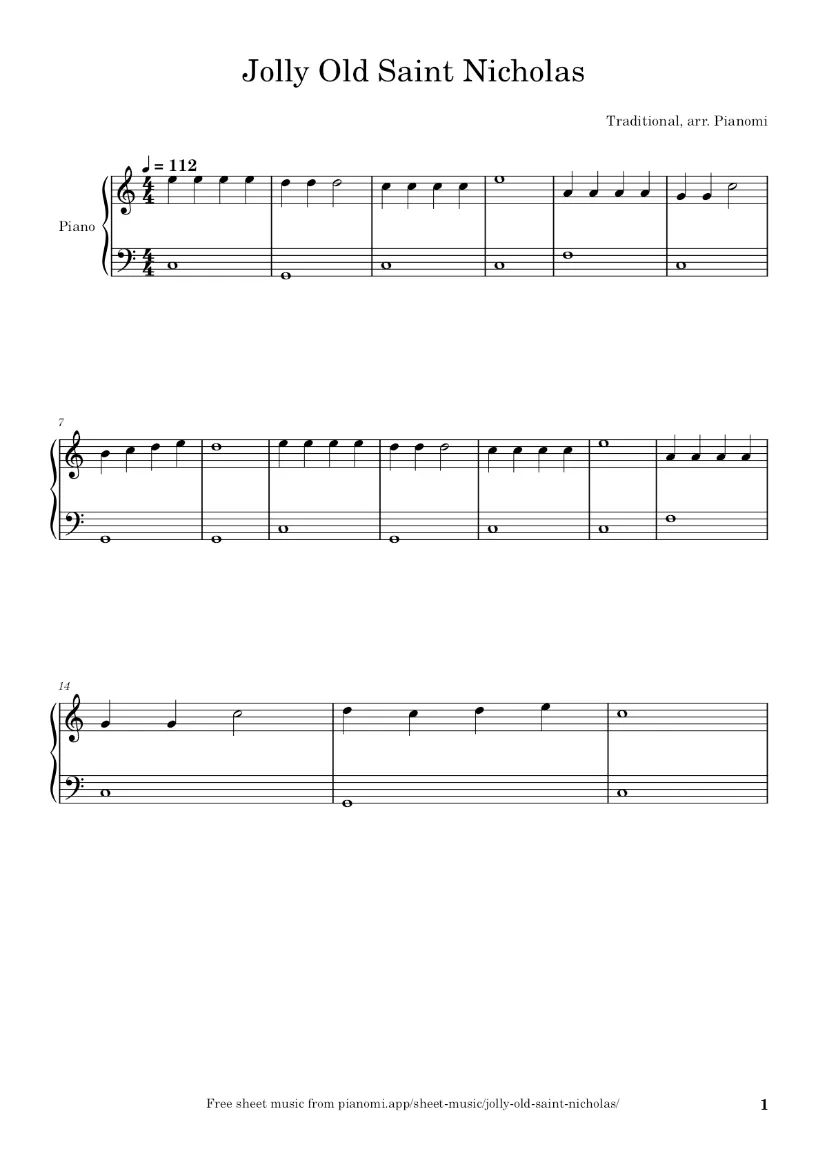
The tune’s notes by name, bar by bar (the right hand’s top line), bars 1–16. ♯ is a sharp, ♭ a flat: play the black key just above or below.
- E E E E
- D D D
- C C C C
- E
- A A A A
- G G C
- B C D E
- D
- E E E E
- D D D
- C C C C
- E
- A A A A
- G G C
- D C D E
- C
The names alone leave out the rhythm and the left hand: the music above has both, and the score with note names prints every note’s name under it.
About Jolly Old Saint Nicholas
Jolly Old Saint Nicholas is an American Christmas song from the 19th century, in which a child asks Santa to lean his ear this way and keep a secret. Its words grew out of a poem by Emily Huntington Miller, “Lilly’s Secret”, printed in the children’s magazine The Little Corporal in December 1865. The music was first printed in 1874 in School Chimes, a school songbook published by S. Brainard’s Sons in Cleveland, and is generally credited to James R. Murray, who compiled it. J. P. McCaskey’s Franklin Square Song Collection (New York, 1881) reprinted it from there.
This arrangement follows the 1874 tune, which The Golden Book of Favorite Songs still printed note for note in 1923, moved from B flat major to C major. The prints have it in 2/4 time; here it’s in 4/4 with every note twice as long, so there are no eighth notes at all, only quarters, halves and wholes. It’s 16 bars: the same eight bars twice, with a different ending.
How hard is Jolly Old Saint Nicholas?
No: it’s one of the easiest pieces here. The right hand plays quarter notes in one place and the left hand one note a bar. The only thing to watch is keeping the repeated notes even.
It reads like level 14 of 44, “G position”: about grade 1 in graded exams’ sight reading, roughly. Its hands, chords and rhythm read like level 8, left hand holds. On top of that: moving out of position. Practise reading at that level with the free sight-reading exercises.
How to practise it
The tune walks down by repeated notes: four Es in bar 1, three Ds in bar 2, four Cs in bar 3, then a long E. Play each repeated note with the same finger, lightly, and keep the beat steady through them. The right hand stays over the six white keys from the G above middle C up to E.
Bar 5 drops to four As, bar 6 is G, G and a half-note C, and bar 7 climbs B, C, D, E to a long D. The second half is the same until bar 15, which starts on D instead of B and leads home to C.
The left hand plays one whole note a bar: the C below middle C, the G below that, and F in bars 5 and 13. Hold each one for all four beats. Learn it alone, then put the hands together, and bring it up to a lively speed.
The score
- Composer
- Traditional
- Key
- C major
- Time
- 4/4
- Tempo
- ♩ = 112
- Length
- 16 bars, under a minute with its repeats
- Range
- G2 to E5
Arranged for piano by Pianomi, from a tune in the public domain.