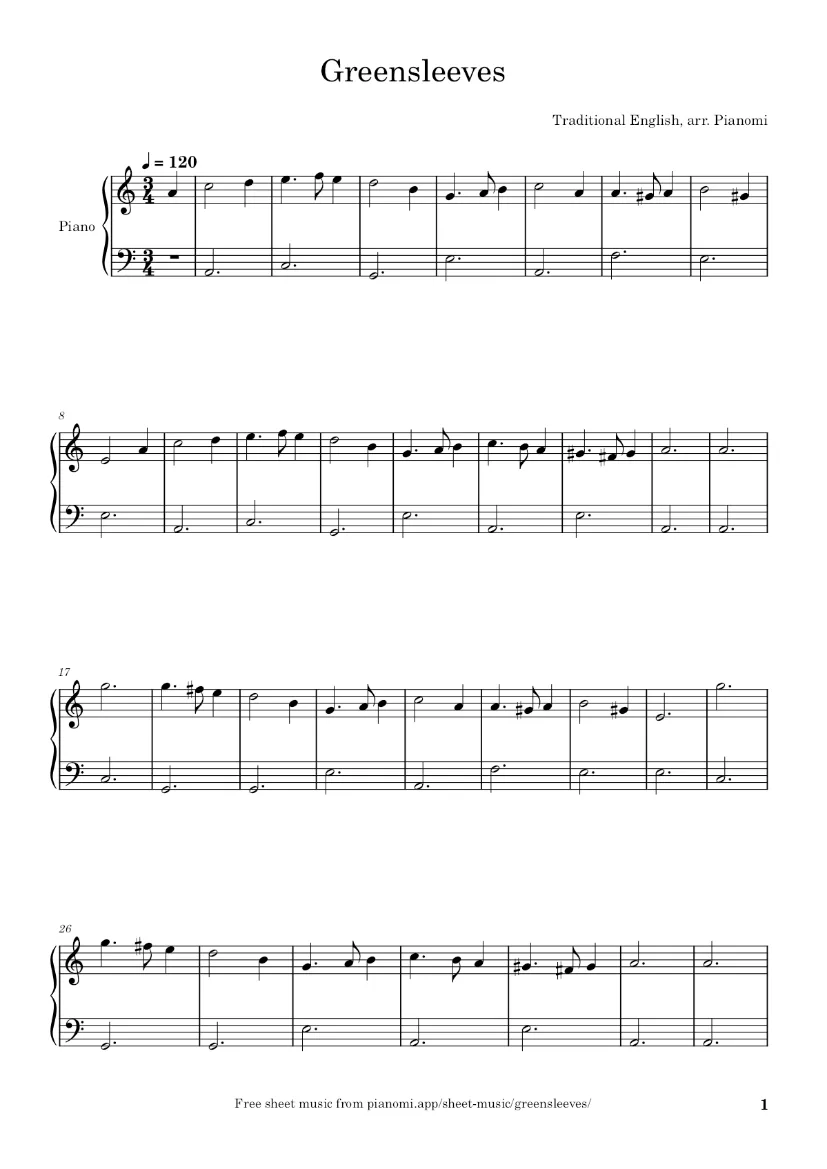
Greensleeves letter notes
The tune’s notes by name, bar by bar (the right hand’s top line), bars 0–16. ♯ is a sharp, ♭ a flat: play the black key just above or below.
- A
- C D
- E F E
- D B
- G A B
- C A
- A G♯ A
- B G♯
- E A
- C D
- E F E
- D B
- G A B
- C B A
- G♯ F♯ G♯
- A
- A
The names alone leave out the rhythm and the left hand: the music above has both, and the score with note names prints every note’s name under it.
About Greensleeves
Greensleeves is an English song of the 16th century, by an unknown author. A ballad called “A new Northern Dittye of the Lady Greene Sleeves” was licensed to the printer Richard Jones in September 1580, and within weeks other ballads were being sung to its tune. Shakespeare names the tune twice in The Merry Wives of Windsor, and it’s in William Ballet’s Lute Book and in Dowland’s lute manuscripts.
The song opens “Alas, my love, you do me wrong”, and its refrain is “Greensleeves was all my joy”. This arrangement follows the tune as William Chappell printed it in Popular Music of the Olden Time (1859), his oldest copy, from Ballet’s Lute Book. He wrote it in E minor and 6/8; here it’s in A minor and 3/4 with every note twice as long, so there are no sixteenth notes. The Christmas carol What Child Is This? is sung to the same melody with other words and differs in three bars, most clearly in the refrain, where this version has Chappell’s F♯ and the carol an F. No words are printed here.
How hard is Greensleeves?
No: the tune moves mostly by step, and the left hand plays one note a bar. The things to watch are the long-short rhythm, the sharps the key signature doesn’t show (G♯ and F♯), and the move up to the high G at the start of the refrain.
It reads like level 30 of 44, “Accidentals”: grade 1 to 2 in graded exams’ sight reading, roughly. Its hands, chords and rhythm read like level 13, eighth notes. On top of that: accidentals, dotted rhythms, moving out of position and left-hand jumps. Practise reading at that level with the free sight-reading exercises.
How to practise it
The tune starts on a pick-up: A on the third beat, “A-”, then C on the first beat of bar 1. Most bars are a half note and a quarter, “long, short”, or a dotted quarter, an eighth and a quarter: count “1, 2 and 3” and let the eighth fall on the “and”. That lilting long-short rhythm runs through the whole song.
The key has no sharps or flats, but the tune has G♯ in bars 6, 7, 14, 22, 23 and 30, and F♯ in bars 14 and 30 and in the refrain’s high F♯ (bars 18 and 26). The refrain starts high, on the G just above the treble staff (bars 17 and 25): move the hand up for it. The left hand plays one note a bar, A, C, G, E or F: learn it alone, then put the hands together slowly.
The score
- Composer
- Traditional English
- Key
- A minor
- Time
- 3/4
- Tempo
- ♩ = 120
- Length
- 33 bars, under a minute with its repeats
- Range
- G2 to G5
Arranged for piano by Pianomi, from a tune in the public domain.