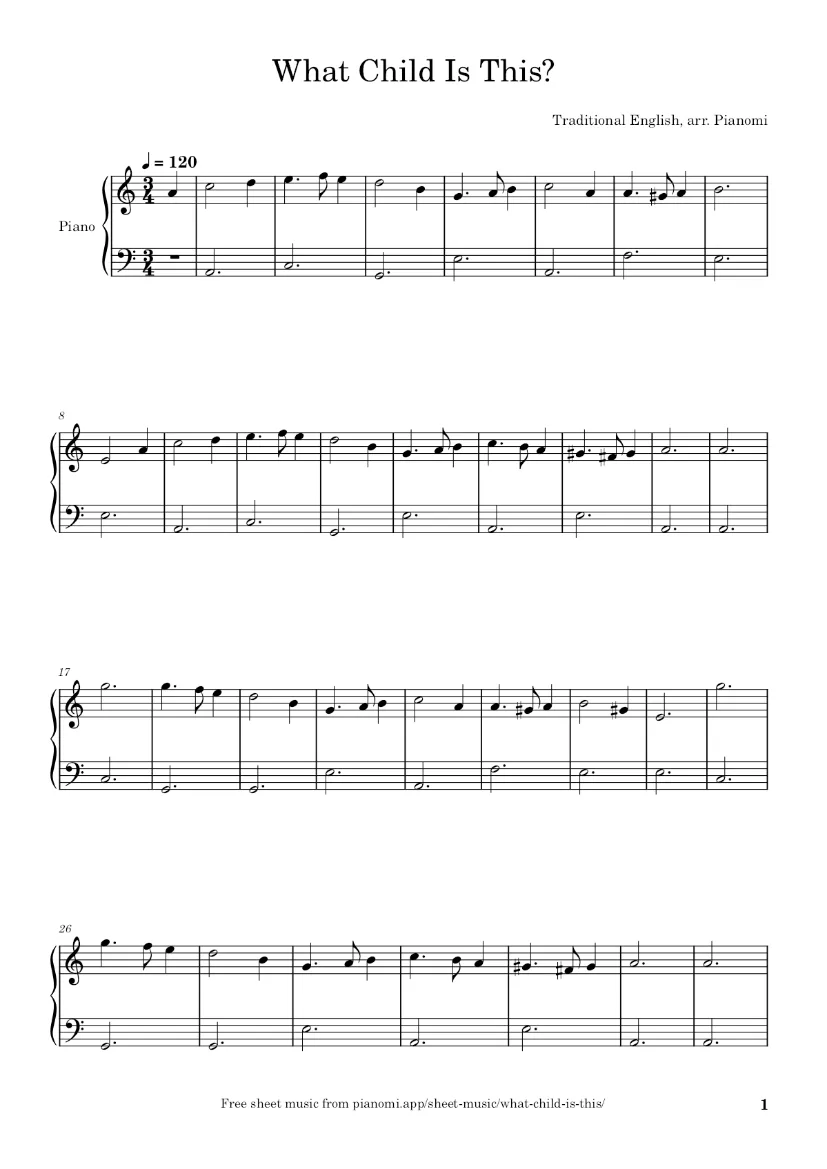
What Child Is This? letter notes
The tune’s notes by name, bar by bar (the right hand’s top line), bars 0–32. ♯ is a sharp, ♭ a flat: play the black key just above or below.
- A
- C D
- E F E
- D B
- G A B
- C A
- A G♯ A
- B
- E A
- C D
- E F E
- D B
- G A B
- C B A
- G♯ F♯ G♯
- A
- A
- G
- G F E
- D B
- G A B
- C A
- A G♯ A
- B G♯
- E
- G
- G F E
- D B
- G A B
- C B A
- G♯ F♯ G♯
- A
- A
The names alone leave out the rhythm and the left hand: the music above has both, and the score with note names prints every note’s name under it.
About What Child Is This?
The words of What Child Is This? are by the English hymn writer William Chatterton Dix (1837–1898), who wrote them around 1865. They are sung to Greensleeves, an anonymous English tune already popular in the 1580s: its ballad was entered at the Stationers’ Company in London in 1580. (It’s often said to be by Henry VIII, without evidence.) Henry Ramsden Bramley and John Stainer put Dix’s words to the tune in their Christmas Carols New and Old (London, Novello), and that is the form sung today: the verse, then a chorus that rises to the tune’s highest notes.
This arrangement follows Bramley and Stainer’s print, checked against Carols Old and Carols New (Boston, 1916), which agrees note for note, moved up a fourth from their E minor to A minor. The tune moves in a gentle 6/8 lilt; here it’s written in 3/4 with every note twice as long, so it reads in quarters and halves. It’s 32 bars after a one-note pick-up: the verse in bars 1 to 16, the chorus in bars 17 to 32. The right hand runs from the E above middle C to the G just above the treble staff.
How hard is What Child Is This??
No, though it’s a little harder than most carols here: the dotted rhythm comes in nearly every other bar, and the minor key’s sharps are new if you’ve only played in C major. The left hand plays one note a bar.
It reads like level 30 of 44, “Accidentals”: grade 1 to 2 in graded exams’ sight reading, roughly. Its hands, chords and rhythm read like level 13, eighth notes. On top of that: accidentals, dotted rhythms, moving out of position and left-hand jumps. Practise reading at that level with the free sight-reading exercises.
How to practise it
Count three beats in every bar. Most bars are long and short: a half note and a quarter, or a dotted quarter, an eighth and a quarter, counted “1, 2 and 3”. The tune’s black keys are G sharp, in bars 6, 14, 22, 23 and 30, and F sharp beside it in bars 14 and 30.
The chorus starts in bar 17 on the high G, held for the whole bar, and comes down G, F, E in bar 18; bar 25 starts it again. The verse’s second half and the chorus’s, bars 9 to 16 and 25 to 32, end differently from their first halves: C, B, A, then G sharp, F sharp, G sharp, and home to A.
The left hand plays one note a bar, held for three beats: A, C, G, E or F below middle C. Learn it alone, then put the hands together slowly, at a gentle, swaying three, about 120 quarter notes a minute.
The score
- Composer
- Traditional English
- Key
- A minor
- Time
- 3/4
- Tempo
- ♩ = 120
- Length
- 33 bars, under a minute with its repeats
- Range
- G2 to G5
Arranged for piano by Pianomi, from a tune in the public domain.