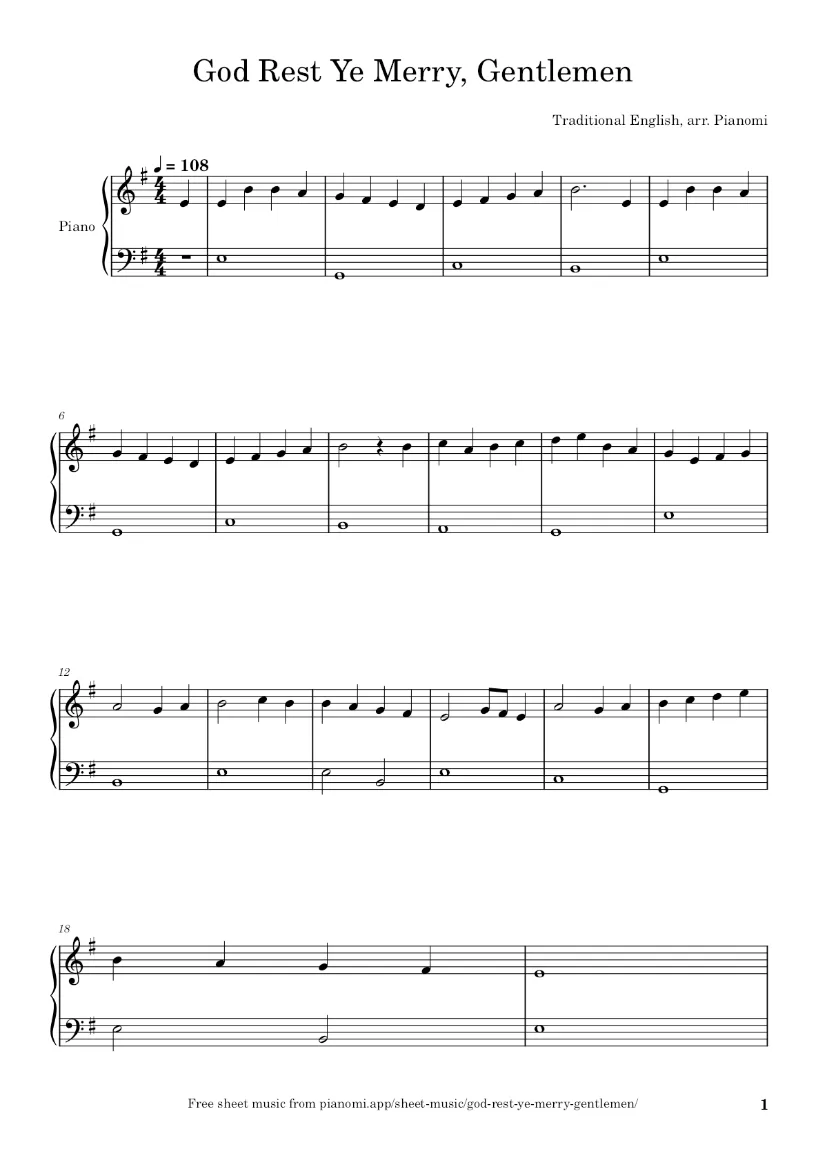
God Rest Ye Merry, Gentlemen letter notes
The tune’s notes by name, bar by bar (the right hand’s top line), bars 0–19. ♯ is a sharp, ♭ a flat: play the black key just above or below.
- E
- E B B A
- G F♯ E D
- E F♯ G A
- B E
- E B B A
- G F♯ E D
- E F♯ G A
- B B
- C A B C
- D E B A
- G E F♯ G
- A G A
- B C B
- B A G F♯
- E G F♯ E
- A G A
- B C D E
- B A G F♯
- E
The names alone leave out the rhythm and the left hand: the music above has both, and the score with note names prints every note’s name under it.
About God Rest Ye Merry, Gentlemen
God Rest Ye Merry, Gentlemen is a traditional English carol: nobody knows who wrote its words or its tune. The comma belongs after “merry”: “God rest you merry” meant “may God keep you merry”, said to the gentlemen. Charles Dickens has a boy start singing it at Scrooge’s keyhole in A Christmas Carol (1843), until Scrooge drives him away.
The tune sung today, in a minor key, with the chorus “O tidings of comfort and joy”, is the one Henry Ramsden Bramley and John Stainer printed as the first carol in their Christmas Carols New and Old (London, Novello). This arrangement follows that print and Carols Old and Carols New (Boston, 1916), which agree note for note, in their key, E minor, with one sharp. It’s 19 bars in 4/4 after a one-note pick-up, the verse and the chorus.
How hard is God Rest Ye Merry, Gentlemen?
No. It’s nearly all quarter notes, mostly by step, and the left hand plays one note a bar. If you’ve only played in C major, the minor key and its F sharps are the new things to get used to.
It reads like level 28 of 44, “Changing positions”: grade 1 to 2 in graded exams’ sight reading, roughly. Its hands, chords and rhythm read like level 9, left hand in halves. On top of that: moving out of position, left-hand jumps and one sharp. The hardest bar is 8. Practise reading at that level with the free sight-reading exercises.
How to practise it
The tune starts on a pick-up, E on beat 4, and moves almost entirely in quarter notes, mostly by step. Bars 1 to 4 and 5 to 8 are the same, except that bar 4 holds B for three beats while bar 8 holds it for two, rests a beat, and goes on from B again.
Every F is F sharp: in bars 2, 3, 6, 7, 11, 14, 15 and 18. The chorus has the tune’s one pair of eighth notes, G and F sharp in bar 15, on beat 3. The top of the tune is the E an octave above the first note, in bars 10 and 17: bar 17 climbs to it step by step, B, C, D, E.
The left hand plays E, G, C, B and A below middle C, one note a bar, with E and then B in bars 14 and 18. Learn it alone, then put the hands together slowly, and keep the quarter notes steady and strong.
The score
- Composer
- Traditional English
- Key
- E minor
- Time
- 4/4
- Tempo
- ♩ = 108
- Length
- 20 bars, under a minute with its repeats
- Range
- G2 to E5
Arranged for piano by Pianomi, from a tune in the public domain.