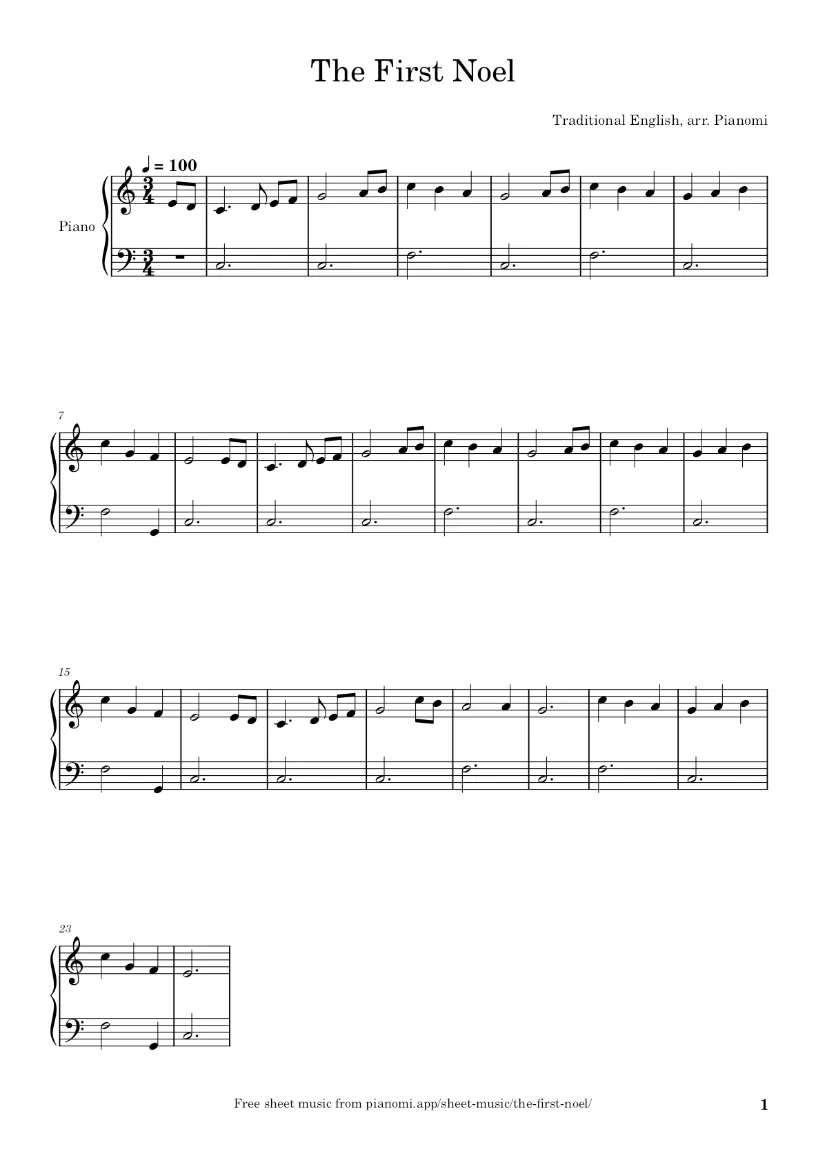
The First Noel letter notes
The tune’s notes by name, bar by bar (the right hand’s top line), bars 0–24. ♯ is a sharp, ♭ a flat: play the black key just above or below.
- E D
- C D E F
- G A B
- C B A
- G A B
- C B A
- G A B
- C G F
- E E D
- C D E F
- G A B
- C B A
- G A B
- C B A
- G A B
- C G F
- E E D
- C D E F
- G C B
- A A
- G
- C B A
- G A B
- C G F
- E
The names alone leave out the rhythm and the left hand: the music above has both, and the score with note names prints every note’s name under it.
About The First Noel
The First Noel is an old traditional English carol. Its words were first printed in 1823, in the second edition of Davies Gilbert’s Some Ancient Christmas Carols, carols he said came from the West of England, and William Sandys printed them with a tune in 1833, in his Christmas Carols Ancient and Modern. The form of the tune sung today is the one in Christmas Carols New and Old, edited by Henry Ramsden Bramley and John Stainer, with Stainer’s harmony.
This arrangement follows Bramley and Stainer’s print, checked against Father Finn’s Carol Book (Boston, 1917), moved down a tone from their D major to C major. It’s the whole verse and chorus, 24 bars in 3/4 after a two-note pick-up: the verse’s eight bars twice, then the chorus, “Noel, Noel”. The right hand stays between middle C and the C above it.
How hard is The First Noel?
No. The tune moves by step within an octave, in quarter and eighth notes, and the left hand plays one note in most bars. It’s 24 bars, but the verse is the same eight bars twice, so there’s less to learn than it looks.
It reads like level 29 of 44, “Dotted rhythms”: grade 1 to 2 in graded exams’ sight reading, roughly. Its hands, chords and rhythm read like level 13, eighth notes. On top of that: dotted rhythms, moving out of position and left-hand jumps. Practise reading at that level with the free sight-reading exercises.
How to practise it
The pick-up is two eighth notes, E and D, leading down to middle C. Bar 1 is a dotted quarter and three eighths, C, D, E, F: count “1, 2 and 3 and”, with the D on the first “and”. The same bar starts the verse’s second half (bar 9) and the chorus (bar 17).
From there the tune climbs to the C above middle C and walks back down in quarter notes, mostly by step: C, B, A; G, A, B; C, G, F; and a long E. There are no big leaps, so let the hand move along the keys with the tune. The chorus holds its long notes in bars 19 and 20: give them their full length.
The left hand plays the C below middle C in most bars, F in bars 3, 5, 11, 13, 19 and 21, and at the end of each line (bars 7, 15 and 23) F and then the G below it, leading home to C. Learn it alone, then put the hands together slowly.
The score
- Composer
- Traditional English
- Key
- C major
- Time
- 3/4
- Tempo
- ♩ = 100
- Length
- 25 bars, under a minute with its repeats
- Range
- G2 to C5
Arranged for piano by Pianomi, from a tune in the public domain.