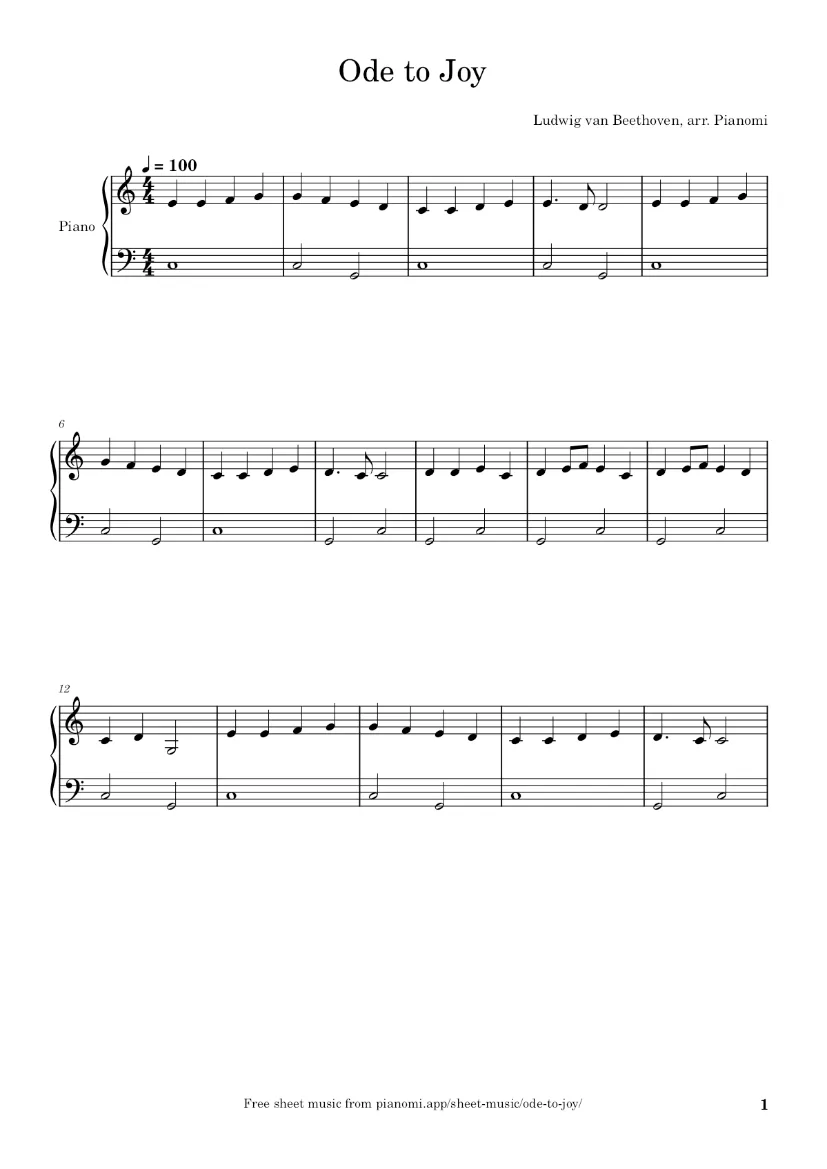
Ode to Joy letter notes
The tune’s notes by name, bar by bar (the right hand’s top line), bars 1–16. ♯ is a sharp, ♭ a flat: play the black key just above or below.
- E E F G
- G F E D
- C C D E
- E D D
- E E F G
- G F E D
- C C D E
- D C C
- D D E C
- D E F E C
- D E F E D
- C D G
- E E F G
- G F E D
- C C D E
- D C C
The names alone leave out the rhythm and the left hand: the music above has both, and the score with note names prints every note’s name under it.
About Ode to Joy
Ode to Joy is the theme of the last movement of Beethoven’s Ninth Symphony, finished in 1824, where a choir and four soloists sing words from Friedrich Schiller’s poem An die Freude (To Joy), written in 1785. The tune alone, without the words, was adopted as the anthem of Europe by the Council of Europe in 1972, and it has been the European Union’s anthem since 1985.
The tune is sixteen bars, nearly all steps between neighbouring notes: two lines that start alike, a middle line, and the first line again. In the symphony that last line comes in a beat early, tied over the barline; here it starts on the beat, which is easier to count.
How hard is Ode to Joy?
No: it’s one of the first pieces in many beginners’ books. The tune moves mostly by step and fits under one hand, and the left hand plays long notes. The dotted rhythms and the one drop below middle C are the only things to watch.
It reads like level 29 of 44, “Dotted rhythms”: grade 1 to 2 in graded exams’ sight reading, roughly. Its hands, chords and rhythm read like level 13, eighth notes. On top of that: dotted rhythms and moving out of position. Practise reading at that level with the free sight-reading exercises.
How to practise it
Put your right thumb on middle C and a finger over each key up to G: the tune stays there, apart from one drop to the G below middle C at the end of bar 12. Reach down to it with your thumb, then come straight back. Count the rhythms out loud: in bars 4, 8 and 16 the long note lasts a beat and a half and the short one comes on the “and” after beat 2, and in bars 10 and 11 the two quick notes share beat 2.
The left hand plays the C below middle C and the G below that, a note every two or four beats. Learn it alone, then put the hands together slowly, and only speed up when you can play all sixteen bars without stopping. The easy Für Elise makes a good next Beethoven piece.
The score
- Composer
- Ludwig van Beethoven (1770–1827)
- Key
- C major
- Time
- 4/4
- Tempo
- ♩ = 100
- Length
- 16 bars, under a minute with its repeats
- Range
- G2 to G4
Arranged for piano by Pianomi, from a tune in the public domain.