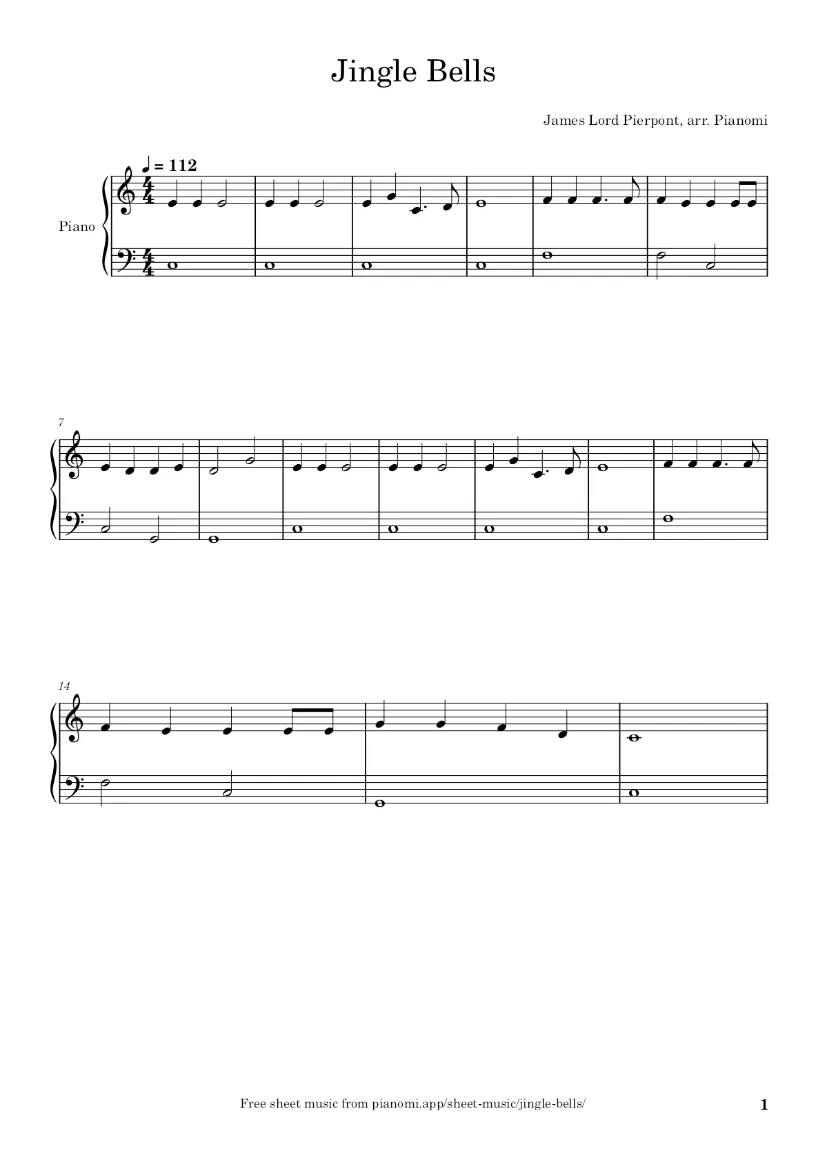
Jingle Bells letter notes
The tune’s notes by name, bar by bar (the right hand’s top line), bars 1–16. ♯ is a sharp, ♭ a flat: play the black key just above or below.
- E E E
- E E E
- E G C D
- E
- F F F F
- F E E E E
- E D D E
- D G
- E E E
- E E E
- E G C D
- E
- F F F F
- F E E E E
- G G F D
- C
The names alone leave out the rhythm and the left hand: the music above has both, and the score with note names prints every note’s name under it.
About Jingle Bells
Jingle Bells was written by James Lord Pierpont and first published in Boston in 1857 as The One Horse Open Sleigh, then again in 1859 as Jingle Bells, or The One Horse Open Sleigh. Its words are about a sleigh ride in the snow and never mention Christmas: it became a Christmas song in the decades that followed.
This arrangement is the chorus, sixteen bars, as it’s sung today: Pierpont’s own chorus of 1857 went quite differently. The right hand never leaves the five keys from middle C to G, and the left hand plays the C and F below middle C and the G below them.
How hard is Jingle Bells?
No. The right hand stays on five keys and the left hand plays long notes. The dotted rhythms and the quick pair of Es in bars 6 and 14 are the parts to count carefully.
It reads like level 29 of 44, “Dotted rhythms”: grade 1 to 2 in graded exams’ sight reading, roughly. Its hands, chords and rhythm read like level 13, eighth notes. On top of that: dotted rhythms. Practise reading at that level with the free sight-reading exercises.
How to practise it
Put your thumb on middle C and keep a finger over each key up to G. The chorus starts with seven Es: play them all with your third finger, evenly, and hold the ones at the ends of bars 1 and 2 for two beats. Bar 3 has the leaps: E, up to G, down to C and up to D.
In bars 3, 5, 11 and 13 the third note lasts a beat and a half and the last comes on the “and” after beat 4: count “1, 2, 3, 4 and” out loud. The left hand plays one or two long notes a bar: learn it alone, put the hands together slowly, and only then bring it up to a brisk, steady speed.
The score
- Composer
- James Lord Pierpont
- Key
- C major
- Time
- 4/4
- Tempo
- ♩ = 112
- Length
- 16 bars, under a minute with its repeats
- Range
- G2 to G4
Arranged for piano by Pianomi, from a tune in the public domain.