Away in a Manger letter notes
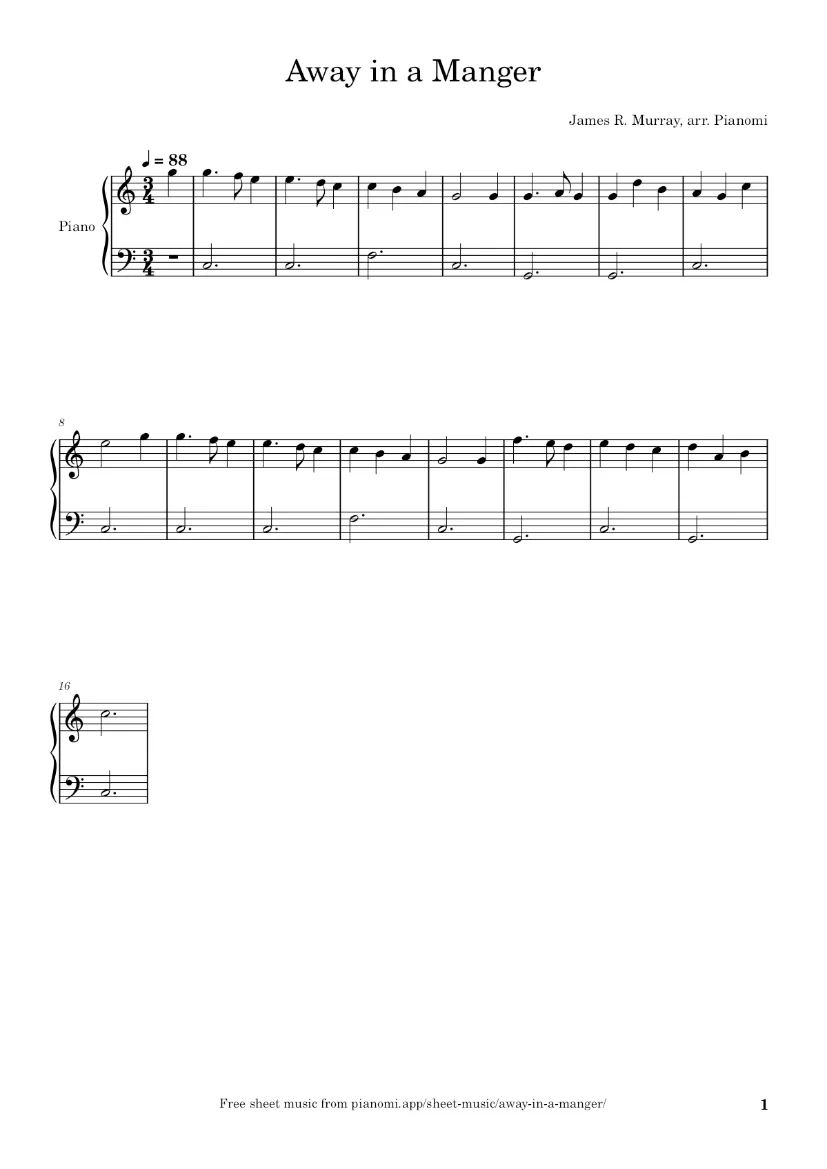
The tune’s notes by name, bar by bar (the right hand’s top line), bars 0–16. ♯ is a sharp, ♭ a flat: play the black key just above or below.
- G
- G F E
- E D C
- C B A
- G G
- G A G
- G D B
- A G C
- E G
- G F E
- E D C
- C B A
- G G
- F E D
- E D C
- D A B
- C
The names alone leave out the rhythm and the left hand: the music above has both, and the score with note names prints every note’s name under it.
About Away in a Manger
The tune most Americans sing to Away in a Manger is by James Ramsey Murray (1841–1905), an American composer. He printed it in 1887 in his songbook Dainty Songs for Little Lads and Lasses, under the title “Luther’s Cradle Hymn”: books of the time said Martin Luther had written the carol for his children, a story with nothing behind it. The words are anonymous, and American. The tune came to be known as Mueller. In Britain the same words are usually sung to another tune, William J. Kirkpatrick’s Cradle Song (1895).
This arrangement is Murray’s tune as two American hymnbooks printed it, Gloria Deo (1901) and Gems of Christmas Song (1910), which agree note for note, moved up from their F major to C major. It’s 16 bars in 3/4 after a one-note pick-up. The right hand runs from the G above middle C to the G an octave higher; the left hand holds one note a bar, C, F or G.
How hard is Away in a Manger?
No. It’s mostly quarter notes with one dotted rhythm that keeps coming back, and the left hand plays one note a bar. The thing to practise is moving the right hand down the octave and back up smoothly.
It reads like level 29 of 44, “Dotted rhythms”: grade 1 to 2 in graded exams’ sight reading, roughly. Its hands, chords and rhythm read like level 13, eighth notes. On top of that: dotted rhythms and moving out of position. Practise reading at that level with the free sight-reading exercises.
How to practise it
The tune starts on a pick-up, the high G on beat 3, and then falls: bar 1 is G, F, E, a dotted quarter, an eighth and a quarter, counted “1, 2 and 3”. The same rhythm comes back in bars 2, 5, 9, 10 and 13.
In the first four bars the tune comes down a whole octave, from the high G to the G in bar 4, mostly by step: let the hand move down with it. Bars 5 to 8 climb back up, to the high G at the end of bar 8, and the second half begins again from there.
The left hand plays the C below middle C in most bars, F in bars 3 and 11, and the G below in bars 5, 6, 13 and 15. Learn it alone, then put the hands together slowly. It’s a lullaby: play it softly and gently, at about 88 quarter notes a minute.
The score
- Composer
- James R. Murray
- Key
- C major
- Time
- 3/4
- Tempo
- ♩ = 88
- Length
- 17 bars, under a minute with its repeats
- Range
- G2 to G5
Arranged for piano by Pianomi, from a tune in the public domain.