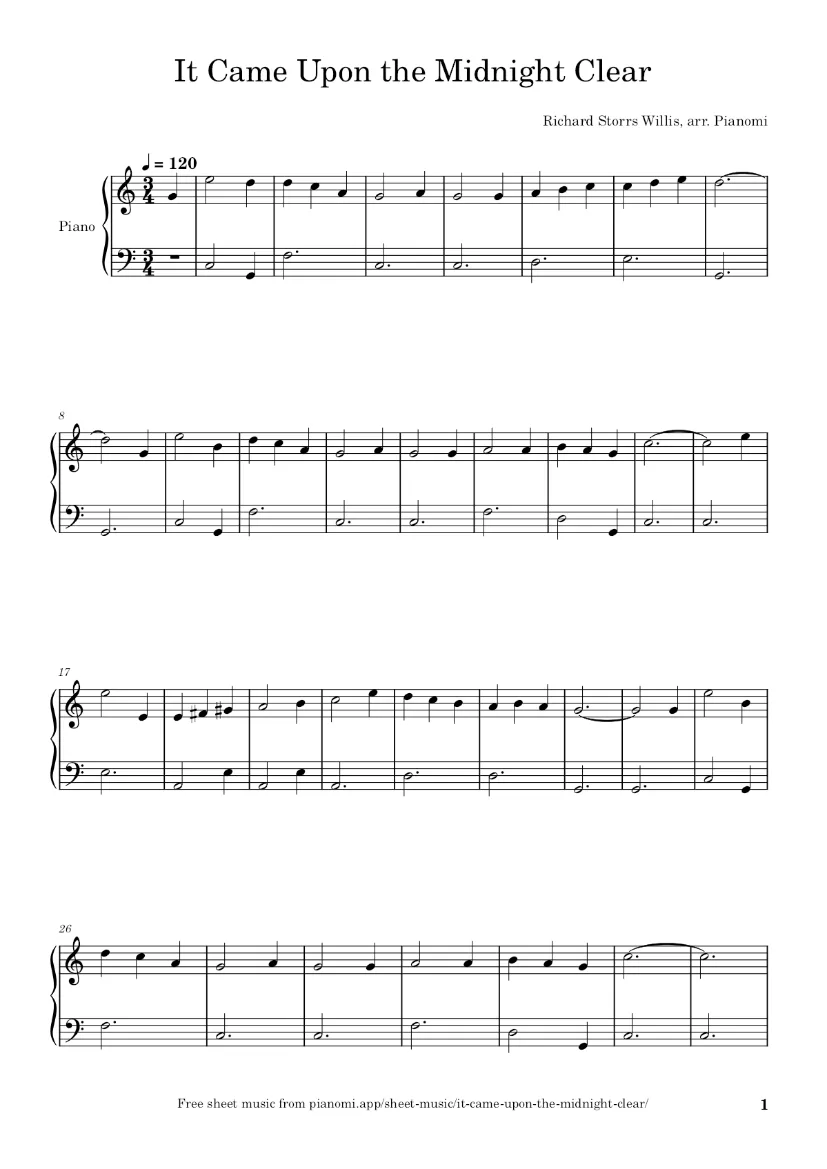
It Came Upon the Midnight Clear letter notes
The tune’s notes by name, bar by bar (the right hand’s top line), bars 0–32. ♯ is a sharp, ♭ a flat: play the black key just above or below.
- G
- E D
- D C A
- G A
- G G
- A B C
- C D E
- D
- G
- E B
- D C A
- G A
- G G
- A A
- B A G
- C
- E
- E E
- E F♯ G♯
- A B
- C E
- D C B
- A B A
- G
- G
- E B
- D C A
- G A
- G G
- A A
- B A G
- C
- held
The names alone leave out the rhythm and the left hand: the music above has both, and the score with note names prints every note’s name under it.
About It Came Upon the Midnight Clear
The words are by Edmund Hamilton Sears (1810–1876), a Unitarian minister in Wayland, Massachusetts, and were first printed in The Christian Register in Boston at the end of 1849. It’s one of the few carols that hardly mentions the Nativity itself: it’s about the angels’ song of peace. The tune sung in America is by Richard Storrs Willis (1819–1900), a composer and music critic who had studied in Germany, and dates from about 1850; its name is Carol. In Britain the words are usually sung to a different, English tune, Noel, which Arthur Sullivan adapted in 1874.
This arrangement follows Willis’s tune as The Church Hymnal (Boston, 1894) and Gloria Deo (New York, 1901) print it, which agree note for note, moved up a tone from their B flat major to C major. Willis wrote it in 6/8; here it’s in 3/4 with every note twice as long, so it reads in quarter and half notes. It’s 32 bars after a one-note pick-up: four lines of eight bars, the last line the same as the second. The right hand stays between the E above middle C and the E an octave higher.
How hard is It Came Upon the Midnight Clear?
No. It’s quarter and half notes in a steady three, and the left hand plays long notes. The tied notes at the ends of the lines, and the F sharp and G sharp in bar 18, are the things to practise slowly.
It reads like level 26 of 44, “Alberti bass”: grade 1 to 2 in graded exams’ sight reading, roughly. Its hands, chords and rhythm read like level 12, waltz time. On top of that: moving out of position and left-hand jumps. The hardest bars are 17 and 18. Practise reading at that level with the free sight-reading exercises.
How to practise it
The tune starts on a pick-up, G on beat 3, and leaps up to the high E, its top note, on the first beat of bar 1. Count three beats in every bar: most bars are a half note and a quarter, or three quarter notes. The long notes at the end of each line, in bars 7 and 8, 15 and 16, and 23 and 24, are tied across the bar line: hold them for five beats, and play the pick-up into the next line on the sixth.
The third line, from bar 17, drops an octave from the high E to the E above middle C, then climbs E, F sharp, G sharp to A in bars 18 and 19: the carol’s only black keys. Bars 20 to 24 come back down from the high E to G.
The left hand plays one note a bar in most bars, C, F or the G below, with D and E rising under the tune in bars 5 and 6, and E, A and D under the third line. In bars 1, 9, 14, 18, 19, 25 and 30 it plays two notes, a half note and a quarter. Learn it alone, then put the hands together slowly, at a gentle, flowing three.
The score
- Composer
- Richard Storrs Willis
- Key
- C major
- Time
- 3/4
- Tempo
- ♩ = 120
- Length
- 33 bars, under a minute with its repeats
- Range
- G2 to E5
Arranged for piano by Pianomi, from a tune in the public domain.