Good King Wenceslas letter notes
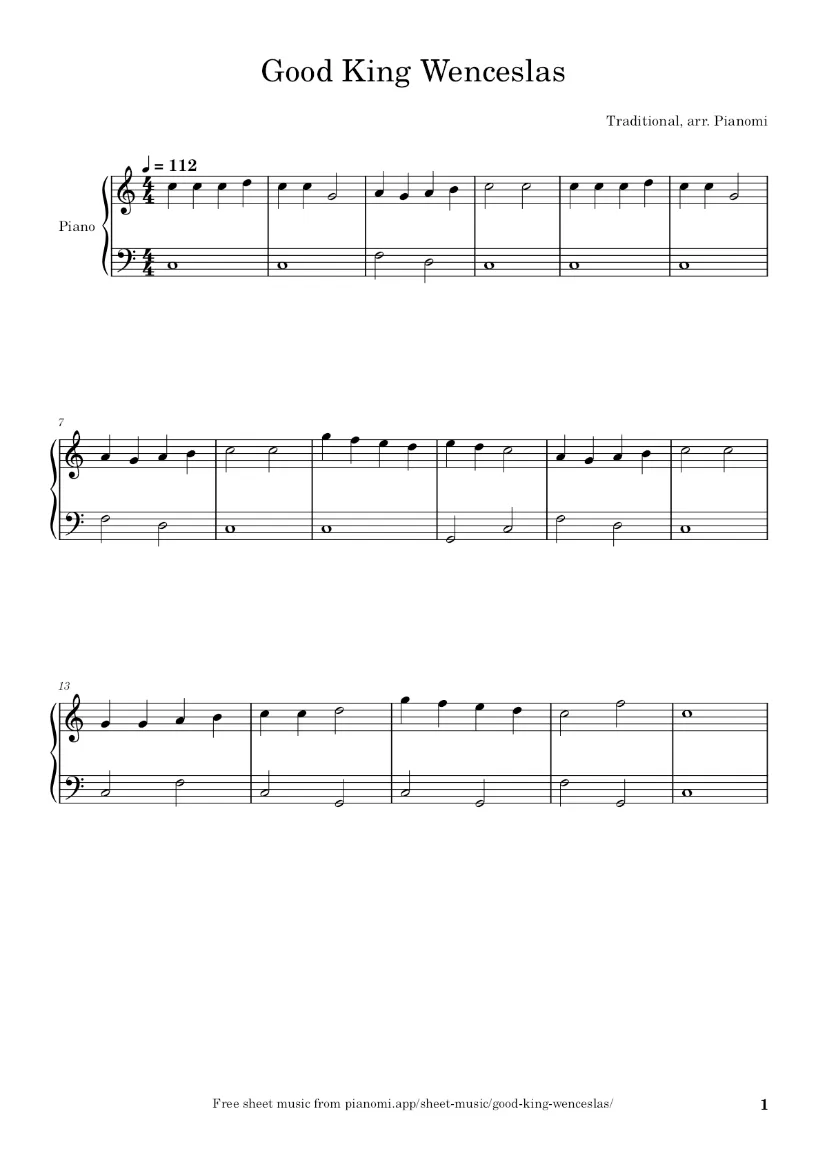
The tune’s notes by name, bar by bar (the right hand’s top line), bars 1–17. ♯ is a sharp, ♭ a flat: play the black key just above or below.
- C C C D
- C C G
- A G A B
- C C
- C C C D
- C C G
- A G A B
- C C
- G F E D
- E D C
- A G A B
- C C
- G G A B
- C C D
- G F E D
- C F
- C
The names alone leave out the rhythm and the left hand: the music above has both, and the score with note names prints every note’s name under it.
About Good King Wenceslas
The words of Good King Wenceslas are by the English clergyman and hymn writer John Mason Neale (1818–1866), who published them with Thomas Helmore in Carols for Christmas-tide (London, 1853). They tell of Wenceslas, a tenth-century duke of Bohemia, going out into the snow on the Feast of Stephen, 26 December, to bring food and firewood to a poor man. Neale set them to Tempus adest floridum (“The time of flowering is here”), a spring carol in Latin, printed in 1582 in Piae Cantiones, a collection of church and school songs from Finland and Sweden.
This arrangement follows the tune as Bramley and Stainer’s Christmas Carols New and Old and Father Finn’s Carol Book (Boston, 1917) print it, moved up a minor third from their A major to C major, with no sharps or flats. It’s the whole verse, 17 bars in 4/4: the first four bars twice, then the climb of bars 9 to 12, and the last line. The right hand stays between the G above middle C and the G an octave higher.
How hard is Good King Wenceslas?
No. It’s one of the easiest carols here: quarter and half notes, mostly by step, no sharps or flats, and a left hand of long notes. The leaps up to the high G in bars 9 and 15 are the places to look ahead.
It reads like level 14 of 44, “G position”: about grade 1 in graded exams’ sight reading, roughly. Its hands, chords and rhythm read like level 9, left hand in halves. The hardest bar is 16. Practise reading at that level with the free sight-reading exercises.
How to practise it
Nearly every note is a quarter note, one a beat, and the tune moves mostly by step. Bars 1 and 2 are C, C, C, D, then C, C and a half-note G; bar 3 walks A, G, A, B back up to the C of bar 4. Bars 5 to 8 are the same four bars again.
Bar 9 starts on the high G, the top of the tune, and walks down G, F, E, D, then E, D and a half-note C. Bar 13 climbs from G to B, and bar 15 comes down from the high G again. In bar 16 the tune goes up from C to F, and bar 17 holds C for the whole bar.
The left hand plays the C below middle C in most bars, held for the whole bar. In bars 3, 7 and 11 it plays F, then D, as two half notes; in bars 10 and 13 to 16 it also changes halfway, moving between C, F and the G below them. Learn it alone, then put the hands together slowly, at a steady walking speed, about 112 quarter notes a minute.
The score
- Composer
- Traditional
- Key
- C major
- Time
- 4/4
- Tempo
- ♩ = 112
- Length
- 17 bars, under a minute with its repeats
- Range
- G2 to G5
Arranged for piano by Pianomi, from a tune in the public domain.