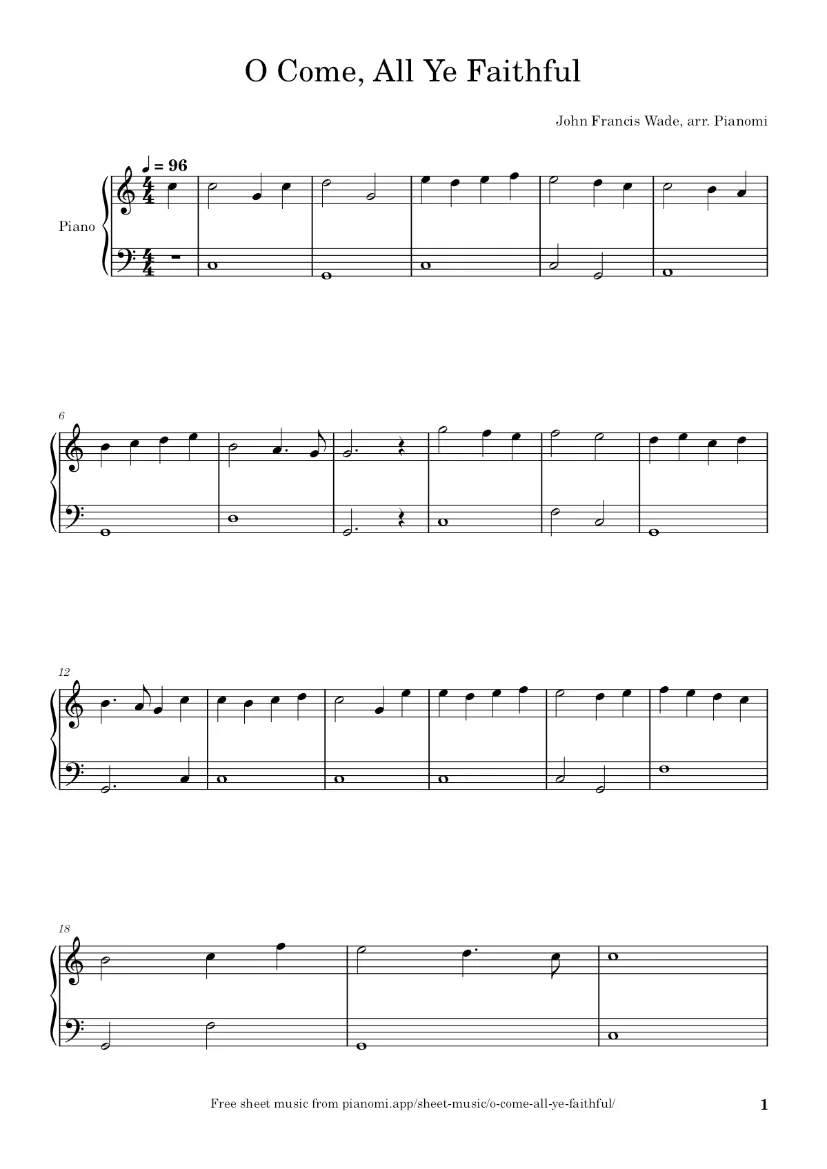
O Come, All Ye Faithful letter notes
The tune’s notes by name, bar by bar (the right hand’s top line), bars 0–20. ♯ is a sharp, ♭ a flat: play the black key just above or below.
- C
- C G C
- D G
- E D E F
- E D C
- C B A
- B C D E
- B A G
- G
- G F E
- F E
- D E C D
- B A G C
- C B C D
- C G E
- E D E F
- E D E
- F E D C
- B C F
- E D C
- C
The names alone leave out the rhythm and the left hand: the music above has both, and the score with note names prints every note’s name under it.
About O Come, All Ye Faithful
O Come, All Ye Faithful began as a Latin hymn, Adeste Fideles. Its earliest known copies are in the manuscripts of John Francis Wade (1711–1786), an English Catholic living in exile in France who made his living copying music; one of them dates from 1751. The tune was long credited to others, among them the English composer John Reading, and in England it was called the Portuguese Hymn, after it was heard at the chapel of the Portuguese embassy in London. Frederick Oakeley translated it into English in 1841, and his words were printed in the form that begins “O come, all ye faithful” in 1852.
This arrangement is the tune as it’s sung today, as The Golden Book of Favorite Songs (Chicago, 1923) prints it, checked against Carols Old and Carols New (Boston, 1916), and moved to C major. It’s 20 bars in 4/4 after a one-note pick-up: the verse, then the refrain, “O come, let us adore Him”, three times, building each time, and the last line. The right hand runs from the G above middle C to the G an octave higher.
How hard is O Come, All Ye Faithful?
No. The tune moves mostly by step in quarter notes, and the left hand plays one or two long notes a bar. The dotted rhythms in bars 7, 12 and 19 and the octave leap into bar 9 are the places to slow down.
It reads like level 29 of 44, “Dotted rhythms”: grade 1 to 2 in graded exams’ sight reading, roughly. Its hands, chords and rhythm read like level 13, eighth notes. On top of that: dotted rhythms, moving out of position and left-hand jumps. The hardest bar is 8. Practise reading at that level with the free sight-reading exercises.
How to practise it
The tune starts on a pick-up, C on beat 4, then C again on the first beat of bar 1. Most of it is quarter and half notes. The quick notes are the dotted pairs: in bars 7 and 19 a half note, then a dotted quarter and an eighth, counted “1, 2, 3, 4 and”; in bar 12 a dotted quarter and an eighth on the first two beats, “1, 2 and”.
Bar 8 holds G for three beats, then both hands rest for a beat. Right after it the tune leaps an octave, to the high G at the start of bar 9, the top of the carol: look at it during the rest, and move the whole hand.
The left hand plays the C below middle C and the G below that for most of the carol, with an A in bar 5, a D in bar 7 and an F in bars 10, 17 and 18; in some bars it changes halfway. Learn it alone, then put the hands together slowly, and play it broad and steady, at about 96 quarter notes a minute.
The score
- Composer
- John Francis Wade
- Key
- C major
- Time
- 4/4
- Tempo
- ♩ = 96
- Length
- 21 bars, about 1 minute with its repeats
- Range
- G2 to G5
Arranged for piano by Pianomi, from a tune in the public domain.