Yankee Doodle letter notes
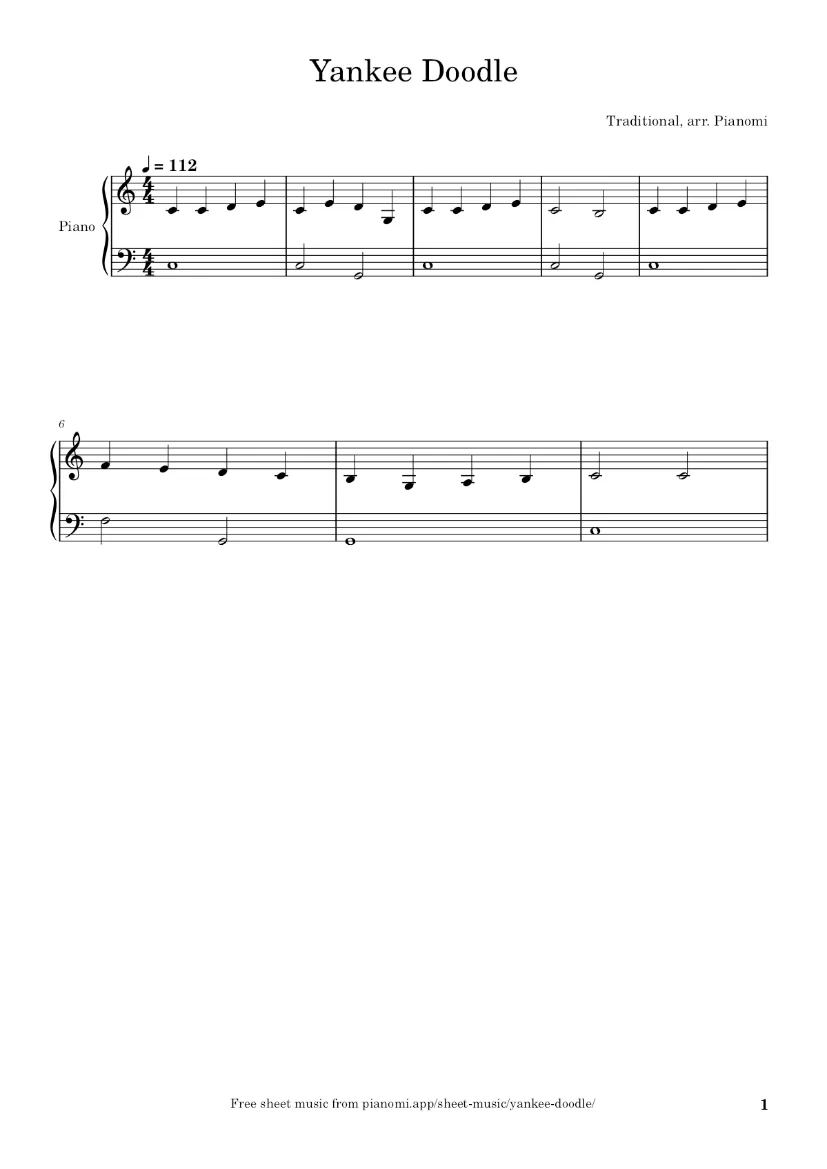
The tune’s notes by name, bar by bar (the right hand’s top line), bars 1–8. ♯ is a sharp, ♭ a flat: play the black key just above or below.
- C C D E
- C E D G
- C C D E
- C B
- C C D E
- F E D C
- B G A B
- C C
The names alone leave out the rhythm and the left hand: the music above has both, and the score with note names prints every note’s name under it.
About Yankee Doodle
In the 1700s British soldiers sang Yankee Doodle to mock the American colonists as simpletons, and in the American Revolution the Americans took it up as their own. In the words, the Yankee sticks a feather in his cap and calls it macaroni, a word then used for a man dressed in the latest, showiest fashion. The tune is older than the words, and nobody knows for sure where it comes from. Today it’s the state song of Connecticut.
This arrangement is the verse, eight bars: “Yankee Doodle went to town, a-riding on a pony” and the line about the feather. The chorus isn’t in it. The right hand plays around middle C, and the left hand plays the C and F below middle C and the G below them.
How hard is Yankee Doodle?
Not very. It’s eight bars with a steady rhythm and long notes in the left hand. The right hand moves more than in tunes that stay under five fingers, which makes it a good piece once you’ve played a few of those.
It reads like level 28 of 44, “Changing positions”: grade 1 to 2 in graded exams’ sight reading, roughly. Its hands, chords and rhythm read like level 9, left hand in halves. On top of that: moving out of position and left-hand jumps. Practise reading at that level with the free sight-reading exercises.
How to practise it
It’s brisker than most first tunes, with a note on every beat, so learn the right hand slowly. Every bar has four even quarter notes, except bars 4 and 8, which have two half notes. The tune dips below middle C to B and G and climbs to F, so it doesn’t sit under one hand: keep to the same fingers each time, and the Fingering link above writes suggested ones on the score.
The left hand plays one or two long notes a bar. Count “1, 2, 3, 4” as you play hands apart, then together at half speed, and keep the beat steady all the way, like a march.
The score
- Composer
- Traditional
- Key
- C major
- Time
- 4/4
- Tempo
- ♩ = 112
- Length
- 8 bars, under a minute with its repeats
- Range
- G2 to F4
Arranged for piano by Pianomi, from a tune in the public domain.