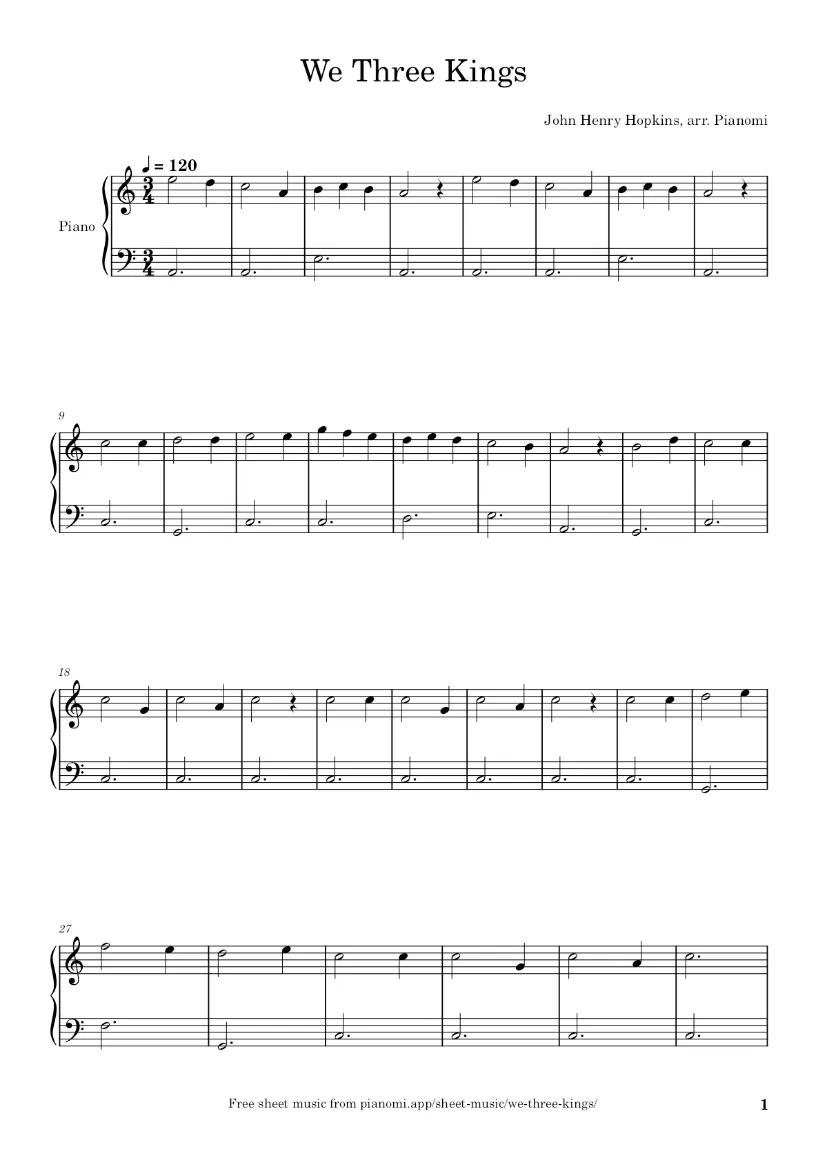
We Three Kings letter notes
The tune’s notes by name, bar by bar (the right hand’s top line), bars 1–32. ♯ is a sharp, ♭ a flat: play the black key just above or below.
- E D
- C A
- B C B
- A
- E D
- C A
- B C B
- A
- C C
- D D
- E E
- G F E
- D E D
- C B
- A
- B D
- C C
- C G
- C A
- C
- C C
- C G
- C A
- C
- C C
- D E
- F E
- D E
- C C
- C G
- C A
- C
The names alone leave out the rhythm and the left hand: the music above has both, and the score with note names prints every note’s name under it.
About We Three Kings
John Henry Hopkins Jr. (1820–1891), an American Episcopal clergyman, wrote the words and music of We Three Kings in 1857, and published it in 1863 in his book Carols, Hymns, and Songs as “Three Kings of Orient”. He wrote it to be sung by three kings, Gaspard, Melchior and Balthazar: they sing the first and last verses together, and in between each sings a verse alone about his gift, gold, frankincense or myrrh, with the chorus “O star of wonder, star of night” after every verse.
This arrangement follows Hopkins’s own 1863 printing, checked against Bramley and Stainer’s English edition: Gaspard’s part in the verse, then the chorus. Hopkins wrote it in E minor and 3/8 time. Here it’s a fourth higher, in A minor, with no sharps or flats, and in 3/4 with every note twice as long, so it reads in quarter and half notes. The verse is in the minor key and the chorus turns to the major, C major here. It’s 32 bars.
How hard is We Three Kings?
No. It’s quarter and half notes, with no black keys, and the left hand plays one note a bar. The rests at the ends of the lines, and keeping the three beats steady, are the things to count.
It reads like level 31 of 44, “Rests”: grade 1 to 2 in graded exams’ sight reading, roughly. Its hands, chords and rhythm read like level 12, waltz time. On top of that: rests. Practise reading at that level with the free sight-reading exercises.
How to practise it
Count three beats in every bar. Most bars of the verse are a half note and a quarter, long and short, and the lines end on a half note and a rest, in bars 4, 8 and 15. In bar 12 the tune reaches its highest note, the G just above the treble staff, and comes down G, F, E.
The chorus starts in bar 16 (“O”) and stays around the C above middle C, coming back to it at the start of nearly every bar: C, C; C, G; C, A. Bars 25 to 28 climb to F and come down, and bar 32 holds C for the whole bar.
The left hand plays one note a bar, held for three beats: A and E under the first eight bars, then C, G, D and E; mostly C under the chorus, with G and F in bars 26 to 28. Learn it alone, then put the hands together slowly, at a steady, swaying three.
The score
- Composer
- John Henry Hopkins
- Key
- C major
- Time
- 3/4
- Tempo
- ♩ = 120
- Length
- 32 bars, under a minute with its repeats
- Range
- G2 to G5
Arranged for piano by Pianomi, from a tune in the public domain.