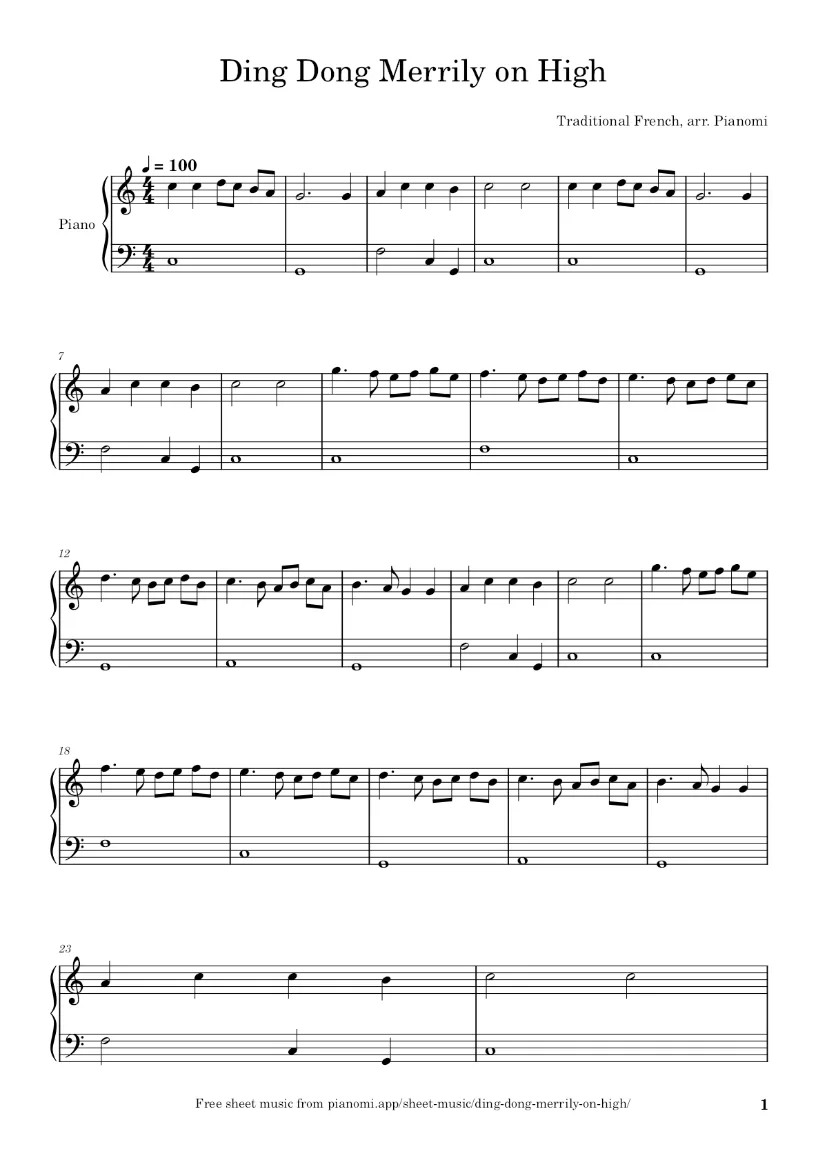
Ding Dong Merrily on High letter notes
The tune’s notes by name, bar by bar (the right hand’s top line), bars 1–24. ♯ is a sharp, ♭ a flat: play the black key just above or below.
- C C D C B A
- G G
- A C C B
- C C
- C C D C B A
- G G
- A C C B
- C C
- G F E F G E
- F E D E F D
- E D C D E C
- D C B C D B
- C B A B C A
- B A G G
- A C C B
- C C
- G F E F G E
- F E D E F D
- E D C D E C
- D C B C D B
- C B A B C A
- B A G G
- A C C B
- C C
The names alone leave out the rhythm and the left hand: the music above has both, and the score with note names prints every note’s name under it.
About Ding Dong Merrily on High
The tune is a 16th-century French dance, the Branle de l’Official. It was printed in 1589 in Orchésographie, a dancing manual written as a dialogue by Thoinot Arbeau, the pen name (an anagram) of Jehan Tabourot, a canon of Langres. The English carol came more than three centuries later: George Ratcliffe Woodward (1848–1934), an Anglican priest who loved old carols and old-fashioned English, wrote words for it beginning “Ding dong! merrily on high”, first printed in The Cambridge Carol-Book (London, SPCK, 1924) with Charles Wood’s harmony.
This arrangement follows the tune as The Cambridge Carol-Book prints it, moved up a tone from its B flat major to C major, with no sharps or flats: the verse’s four bars twice, then the Gloria twice, 24 bars in 4/4. In the Gloria one syllable is stretched over a long run of quick notes, like bells pealing. The right hand stays between the G above middle C and the G an octave higher.
How hard is Ding Dong Merrily on High?
The verse is easy: quarter notes and a few eighths, with no black keys, and the left hand plays long notes. The Gloria’s runs of eighth notes are the hard part: practise them slowly, one bar at a time.
It reads like level 29 of 44, “Dotted rhythms”: grade 1 to 2 in graded exams’ sight reading, roughly. Its hands, chords and rhythm read like level 13, eighth notes. On top of that: dotted rhythms and left-hand jumps. Practise reading at that level with the free sight-reading exercises.
How to practise it
Bar 1 is two quarter notes on C, then four eighths, D, C, B, A, counted “1, 2, 3 and 4 and”, and bar 2 holds G for three beats. Bars 3 and 4 are four quarter notes and two half notes on C. Bars 5 to 8 are the same as bars 1 to 4.
The Gloria starts in bar 9 on the high G. Each of its bars has the same shape, a dotted quarter held through beat 2 and then five eighths from the “and” of 2, and each starts a step lower than the one before: G in bar 9, then F, E, D, and C in bar 13. Practise bar 9 alone until it runs evenly, and the next four bars follow. Bars 14 to 16 bring it home to C, and bars 17 to 24 are the Gloria again.
The left hand plays one note a bar, C, F, or the G or A below them, with F, C and G at the end of each line, in bars 3, 7, 15 and 23. Learn it alone, then put the hands together slowly, and bring it up to a bright, ringing speed, about 100 quarter notes a minute.
The score
- Composer
- Traditional French
- Key
- C major
- Time
- 4/4
- Tempo
- ♩ = 100
- Length
- 24 bars, about 1 minute with its repeats
- Range
- G2 to G5
Arranged for piano by Pianomi, from a tune in the public domain.