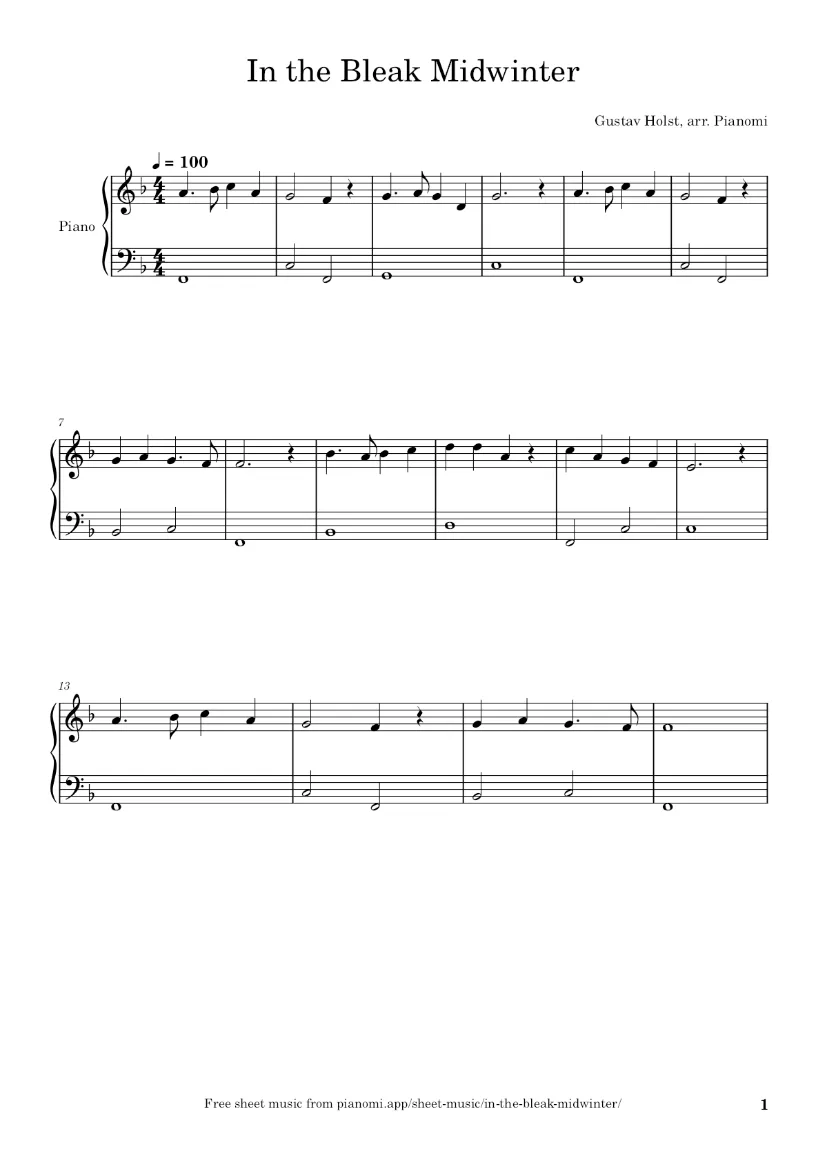
In the Bleak Midwinter letter notes
The tune’s notes by name, bar by bar (the right hand’s top line), bars 1–16. ♯ is a sharp, ♭ a flat: play the black key just above or below.
- A B♭ C A
- G F
- G A G D
- G
- A B♭ C A
- G F
- G A G F
- F
- B♭ A B♭ C
- D D A
- C A G F
- E
- A B♭ C A
- G F
- G A G F
- F
The names alone leave out the rhythm and the left hand: the music above has both, and the score with note names prints every note’s name under it.
About In the Bleak Midwinter
The words are a Christmas poem by the English poet Christina Rossetti (1830–1894), first published in 1872. The tune most people sing, Cranham, named after a village in Gloucestershire, is by Gustav Holst (1874–1934). It was first printed in The English Hymnal of 1906, as hymn 25, with a note that the poem’s metre is irregular: the music is written for the first verse and fits the others with small changes. The Oxford Book of Carols (1928) took it in as a carol, “Mid-Winter”. Harold Darke’s setting of 1909 is a different tune; this page is Holst’s.
This arrangement follows Holst’s tune as The English Hymnal first printed it, checked against Songs of Praise (1925) and The Oxford Book of Carols, in his key, F major, with one flat. It’s the verse once, 16 bars in 4/4: the first line, the same opening again with a different ending, the climb of bars 9 to 12, and the opening once more. The right hand stays between the D above middle C and the D an octave higher.
How hard is In the Bleak Midwinter?
No. It’s quarter, half and dotted notes in F major, with one flat, and the left hand plays long notes. Counting the dotted rhythms and the rests at the ends of the lines is the main thing.
It reads like level 31 of 44, “Rests”: grade 1 to 2 in graded exams’ sight reading, roughly. Its hands, chords and rhythm read like level 13, eighth notes. On top of that: rests, dotted rhythms, one flat and moving out of position. Practise reading at that level with the free sight-reading exercises.
How to practise it
Bars 1, 3, 5, 9 and 13 start with a dotted quarter and an eighth, A then B flat in bar 1, counted “1, 2 and 3, 4”, and bars 7 and 15 have the same rhythm on beats 3 and 4. Every even-numbered bar but the last ends on a rest: let the hand lift, and come in again on the next beat.
The tune climbs in bars 9 and 10, from B flat to the high D, its top note, played twice, then comes down C, A, G, F to a long E in bar 12. Bar 3 dips to the D above middle C, its lowest note.
The left hand plays one long note or two half notes a bar: low F, C, G, B flat and D. Learn it alone, then put the hands together slowly, and play it gently, at about 100 quarter notes a minute.
The score
- Composer
- Gustav Holst
- Key
- F major
- Time
- 4/4
- Tempo
- ♩ = 100
- Length
- 16 bars, under a minute with its repeats
- Range
- F2 to D5
Arranged for piano by Pianomi, from a tune in the public domain.