O Little Town of Bethlehem letter notes
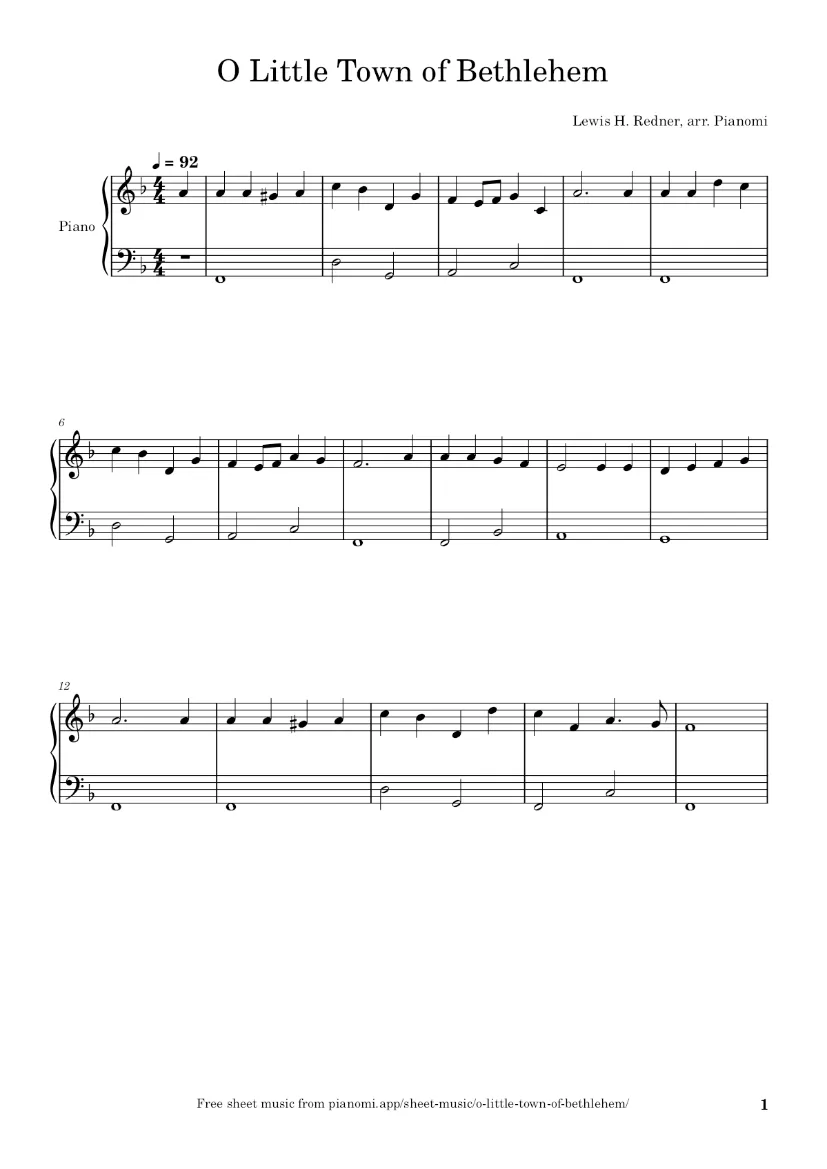
The tune’s notes by name, bar by bar (the right hand’s top line), bars 0–16. ♯ is a sharp, ♭ a flat: play the black key just above or below.
- A
- A A G♯ A
- C B♭ D G
- F E F G C
- A A
- A A D C
- C B♭ D G
- F E F A G
- F A
- A A G F
- E E E
- D E F G
- A A
- A A G♯ A
- C B♭ D D
- C F A G
- F
The names alone leave out the rhythm and the left hand: the music above has both, and the score with note names prints every note’s name under it.
About O Little Town of Bethlehem
Phillips Brooks (1835–1893), rector of Holy Trinity Church in Philadelphia, wrote the words after a visit to Bethlehem in 1865. Lewis H. Redner (1831–1908), the church’s organist, wrote this tune for them in 1868, and its Sunday school first sang it that Christmas. Redner’s tune is named St. Louis, and it’s the one sung in America; in Britain the words are usually sung to Forest Green, an English folk tune.
This arrangement follows Redner’s tune as The Church Hymnal (Boston, 1894) and Gloria Deo (New York, 1901) print it, which agree note for note, moved down a tone from their G major to F major, with one flat, B flat. It’s the whole verse, four lines of four bars after a one-note pick-up: 16 bars in 4/4. The right hand stays between middle C and the D just over an octave above it.
How hard is O Little Town of Bethlehem?
No. It’s mostly quarter and half notes, and the left hand plays long notes. The leaps in bars 2, 6 and 14 and the G sharps in bars 1 and 13 are the places to slow down.
It reads like level 30 of 44, “Accidentals”: grade 1 to 2 in graded exams’ sight reading, roughly. Its hands, chords and rhythm read like level 13, eighth notes. On top of that: accidentals, moving out of position, left-hand jumps and one flat. Practise reading at that level with the free sight-reading exercises.
How to practise it
The tune starts on a pick-up, A on beat 4, and bar 1 goes on from it: A, A, G sharp, A. G sharp, in bars 1 and 13, is the only black key besides B flat. Bars 3 and 7 each have two eighth notes, E and F on beat 2, counted “1, 2 and 3, 4”. The first three lines end on a dotted half note and a pick-up into the next, in bars 4, 8 and 12.
Bar 2 comes down from B flat to the D above middle C, a leap of a sixth, and goes up to G; bar 6 does the same. The third line, bars 9 to 12, comes down to E and climbs D, E, F, G back to A. In bar 14 the tune leaps an octave, from D to the high D, its top note; bar 15 has a dotted quarter and an eighth, A and G, and bar 16 holds F.
The left hand plays one long note or two half notes a bar: mostly low F, with D and G, A and C, and B flat in bar 9. Learn it alone, then put the hands together slowly, at a calm, steady speed, about 92 quarter notes a minute.
The score
- Composer
- Lewis H. Redner
- Key
- F major
- Time
- 4/4
- Tempo
- ♩ = 92
- Length
- 17 bars, under a minute with its repeats
- Range
- F2 to D5
Arranged for piano by Pianomi, from a tune in the public domain.