Angels We Have Heard on High letter notes
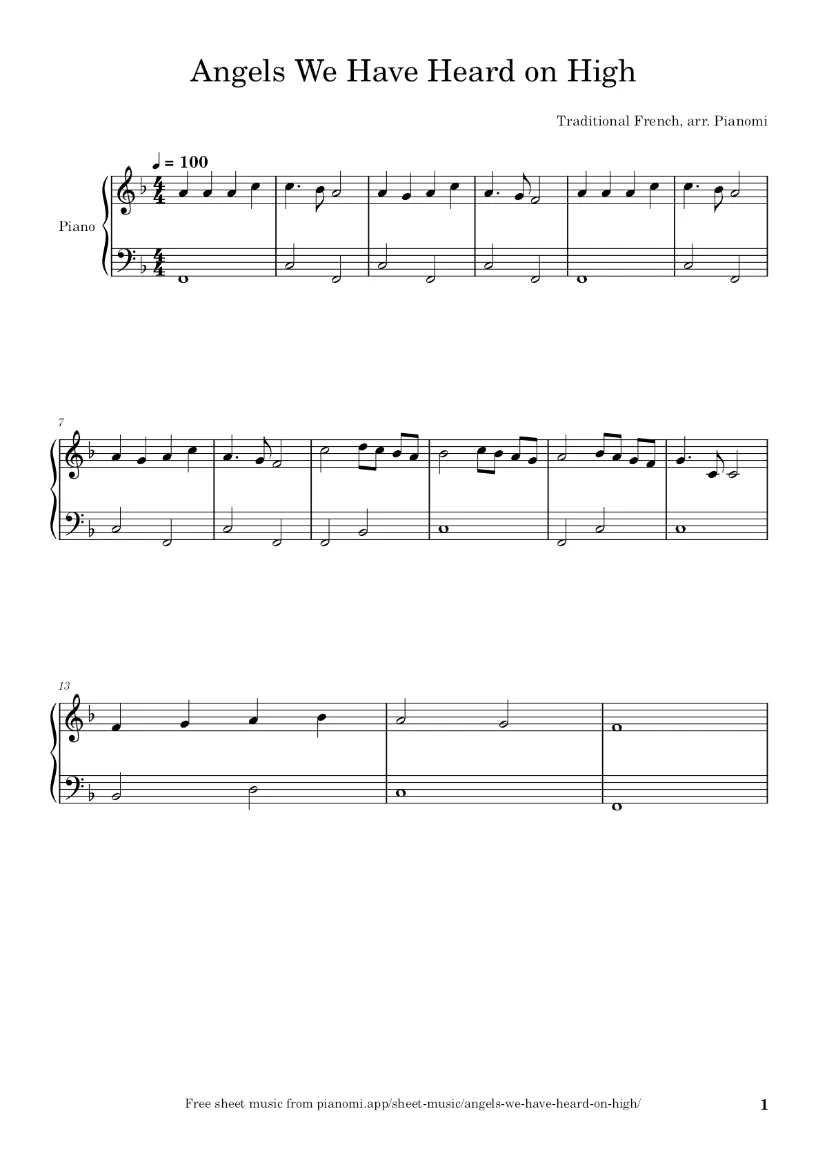
The tune’s notes by name, bar by bar (the right hand’s top line), bars 1–15. ♯ is a sharp, ♭ a flat: play the black key just above or below.
- A A A C
- C B♭ A
- A G A C
- A G F
- A A A C
- C B♭ A
- A G A C
- A G F
- C D C B♭ A
- B♭ C B♭ A G
- A B♭ A G F
- G C C
- F G A B♭
- A G
- F
The names alone leave out the rhythm and the left hand: the music above has both, and the score with note names prints every note’s name under it.
About Angels We Have Heard on High
Angels We Have Heard on High is a French carol, Les Anges dans nos campagnes, first printed in France in the 1840s. Its English words, beginning “Angels we have heard on high”, are by James Chadwick (1813–1882), the Catholic bishop of Hexham and Newcastle in the north of England, from 1862. Its refrain stretches the first syllable of “Gloria” over a long run of falling notes, the part everyone remembers.
This arrangement follows the tune as Carols Old and Carols New (Boston, 1916) and Father Finn’s Carol Book (Boston, 1917) print it, in their key, F major, with one flat; an English printing of 1875, Chope’s Carols for Use in Church, agrees on every note. It’s the verse’s four bars, written out twice, and then the refrain once: 15 bars in 4/4. The right hand stays between middle C and the D just over an octave above it.
How hard is Angels We Have Heard on High?
No. The verse is quarter notes and one dotted rhythm, and the left hand plays long notes. The runs of eighth notes in the refrain are the part to practise slowly, a bar at a time.
It reads like level 29 of 44, “Dotted rhythms”: grade 1 to 2 in graded exams’ sight reading, roughly. Its hands, chords and rhythm read like level 13, eighth notes. On top of that: dotted rhythms, moving out of position and one flat. Practise reading at that level with the free sight-reading exercises.
How to practise it
The verse is four bars, played twice. Bars 1 and 3 are four quarter notes; bars 2 and 4 are a dotted quarter, an eighth and a half note, counted “1, 2 and 3, 4”. Bar 4 comes home to F.
The refrain, from bar 9, is the long “Glo-ri-a”: bars 9, 10 and 11 are each a half note and then four eighths, one step up and three down, each bar starting a step lower than the one before, on C, then B flat, then A. Count them “1, 2, 3 and 4 and”, and keep the eighths even. In bar 12 the tune drops to middle C, then climbs F, G, A, B flat in bar 13 and comes home to F.
The left hand plays low F and the C below middle C, mostly a half note each, all through the verse; under the refrain it adds B flat and D. Learn it alone, then put the hands together slowly, at about 100 quarter notes a minute.
The score
- Composer
- Traditional French
- Key
- F major
- Time
- 4/4
- Tempo
- ♩ = 100
- Length
- 15 bars, under a minute with its repeats
- Range
- F2 to D5
Arranged for piano by Pianomi, from a tune in the public domain.