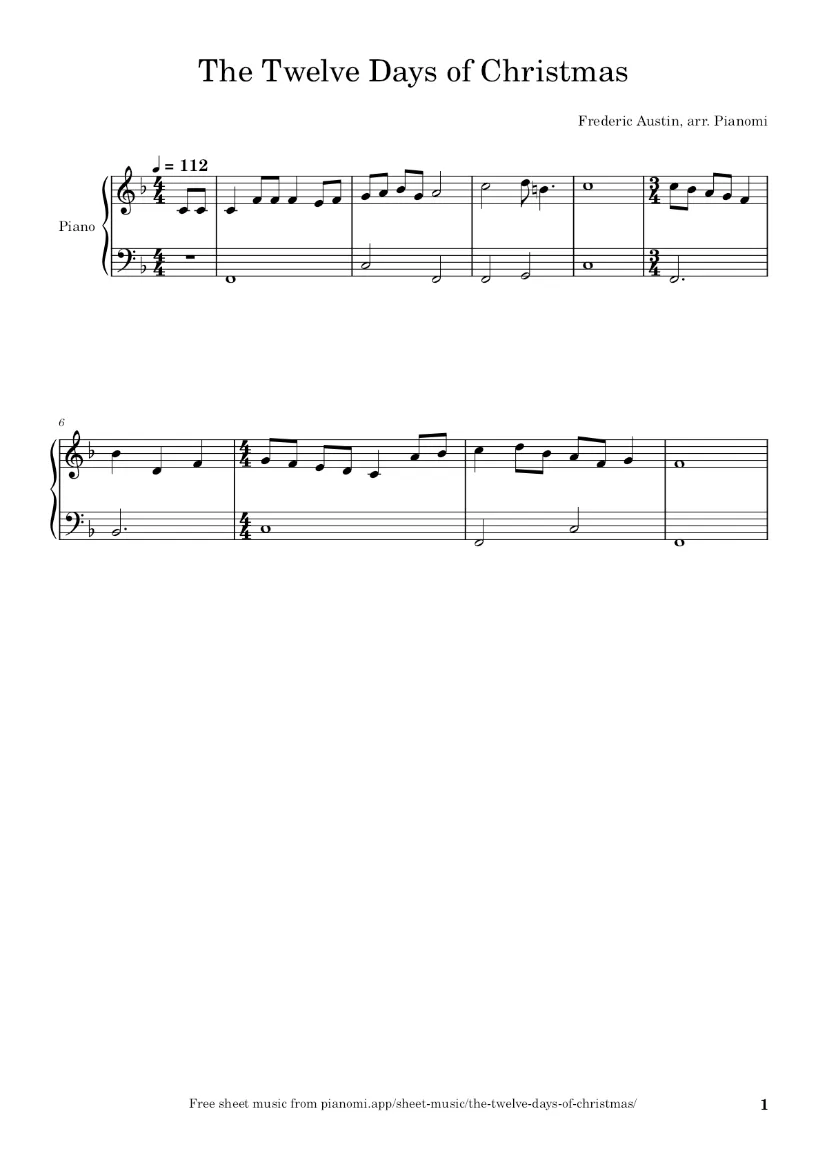
The Twelve Days of Christmas letter notes
The tune’s notes by name, bar by bar (the right hand’s top line), bars 0–9. ♯ is a sharp, ♭ a flat: play the black key just above or below.
- C C
- C F F F E F
- G A B♭ G A
- C D B
- C
- C B♭ A G F
- B♭ D F
- G F E D C A B♭
- C D B♭ A F G
- F
The names alone leave out the rhythm and the left hand: the music above has both, and the score with note names prints every note’s name under it.
About The Twelve Days of Christmas
The Twelve Days of Christmas is a traditional English counting song, first printed in Mirth without Mischief in London around 1780. Its gifts pile up verse by verse, from a partridge in a pear tree to the twelfth day. The tune sung today is usually credited to Frederic Austin (1872–1952), an English baritone, whose arrangement Novello published in London in 1909, dedicated to Hamilton Harty. In a note printed with it, Austin says the song was sung in his family when he was a child, and that he wrote it down as well as he remembered it.
This easy version is one verse, the fifth day, the first with the whole tune as it’s sung from then on: the slow, grand “Five gold rings”, which Austin marks allargando, broadening, then the falling “Four calling birds, three French hens” in two bars of 3/4. It follows Austin’s 1909 print in his key, F major, with one flat: 9 bars after a two-note pick-up, in 4/4 but for those two bars. The right hand stays between middle C and the D just over an octave above it.
How hard is The Twelve Days of Christmas?
Not very. It’s short, and the left hand plays long notes, but most bars have eighth notes, there’s a B natural, and two bars of 3/4 come in the middle of the 4/4. Count those two bars slowly, three beats each, before you play it up to speed.
It reads like level 28 of 44, “Changing positions”: grade 1 to 2 in graded exams’ sight reading, roughly. Its hands, chords and rhythm read like level 13, eighth notes. On top of that: syncopation, accidentals, dotted rhythms, moving out of position and one flat. The hardest bar is 3. Practise reading at that level with the free sight-reading exercises.
How to practise it
The pick-up is two eighth notes on middle C, and bar 1 starts on C again, then climbs to F: C, F and F, F, E and F, counted “1, 2 and 3, 4 and”. Bar 2 walks up G, A, B flat, G in eighths to a long A.
Bars 3 and 4 are “Five gold rings”: a half-note C, an eighth D, then B natural, the one note outside the key, held for three eighths, and a whole bar of C. Play them broadly, a little slower. Bars 5 and 6 have three beats each, not four: bar 5 falls C, B flat, A, G in eighths to a quarter-note F, and bar 6 is three quarter notes, B flat, the D below and F. Then 4/4 comes back for the last three bars, and bar 9 holds F for the whole bar.
The left hand plays long notes, one or two a bar: low F, the C below middle C, and the G and B flat between them. Learn it alone, then put the hands together slowly, at about 112 quarter notes a minute, keeping bars 5 and 6 to three beats.
The score
- Composer
- Frederic Austin
- Key
- F major
- Time
- 4/4 (it changes)
- Tempo
- ♩ = 112
- Length
- 10 bars, under a minute with its repeats
- Range
- F2 to D5
Arranged for piano by Pianomi, from a tune in the public domain.